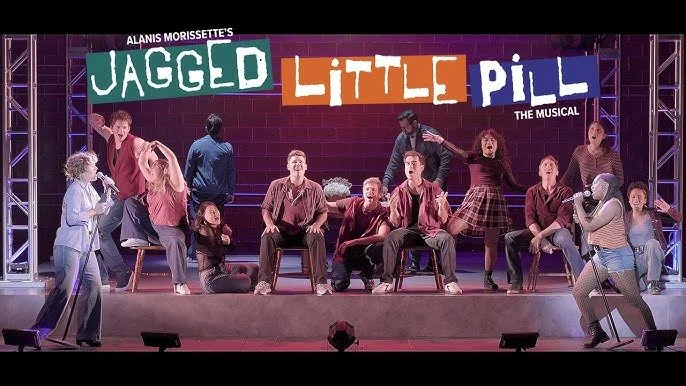
Apparently, lightning does strike twice in Colorado.
After seeing one of the most moving pieces of theater I have experienced in this state earlier in the weekend, I made my way to Colorado Springs for Jagged Little Pill at the Fine Arts Center, thinking I was simply going to see my second show in a few days.
Instead, I left with that particular post-theater silence where your brain is still trying to re-enter your body.
There are weekends when you are reminded that theater is alive. Then there are weekends when theater grabs you by the shoulders, shakes the ground under your feet, and says, “No, really. Pay attention.”
This was one of those weekends.
Jagged Little Pill, with music by Alanis Morissette and Glen Ballard and a book by Diablo Cody, takes Morissette’s generation-defining 1995 album and refracts it through the story of the Healys, a seemingly perfect suburban family whose carefully curated image begins to crack under the weight of addiction, sexual assault, identity, race, queerness, silence, and the brutal cost of pretending everything is fine. It is not a jukebox musical in the easiest sense of the term. At its best, it does not simply place familiar songs into a plot. It lets those songs detonate inside the lives of people who have been swallowing too much for too long.
The musical premiered at the American Repertory Theater in Cambridge in 2018, then transferred to Broadway in 2019. It went on to receive 15 Tony Award nominations, winning Best Book of a Musical for Diablo Cody, and the cast album won the Grammy Award for Best Musical Theater Album. It also arrived with controversy, particularly around the handling of Jo’s gender identity in earlier iterations of the show, which matters because this is a piece that is explicitly asking audiences to look at whose pain gets centered, whose identity gets clarified, and whose truth gets softened for public consumption.
Which is part of why this production at the Fine Arts Center feels so bold.
I do not say that as a throwaway compliment. Producing Jagged Little Pill in Colorado Springs is not a neutral programming choice. This is a show that does not politely tap on the door of difficult subject matter. It kicks the door open, walks into the room, and refuses to lower its voice. It is unflinching about addiction. It is unflinching about rape culture. It is unflinching about queerness, race, family performance, and the violence of silence. In a city and region where the politics around some of these conversations can be, let’s say, complicated, this production does not appear interested in sanding down the edges to make the medicine easier to swallow.
Thank God.
Because the entire point of Jagged Little Pill is that the thing lodged in your throat has to come out eventually.
Quite simply, this production is a work of art from top to bottom. But I would be remiss not to begin unpacking the experience by talking about the technical design, because this is one of those productions where the design does not support the storytelling from underneath. It is storytelling.
A simple lighting truss frames the central elevated playing space, creating something like a jewelry box where most of the show lives. It contains the world, focuses the eye, and gives the production a kind of visual pressure chamber. But that same structure also becomes the architecture for Paige Seber’s wildly bold and audacious lighting design.
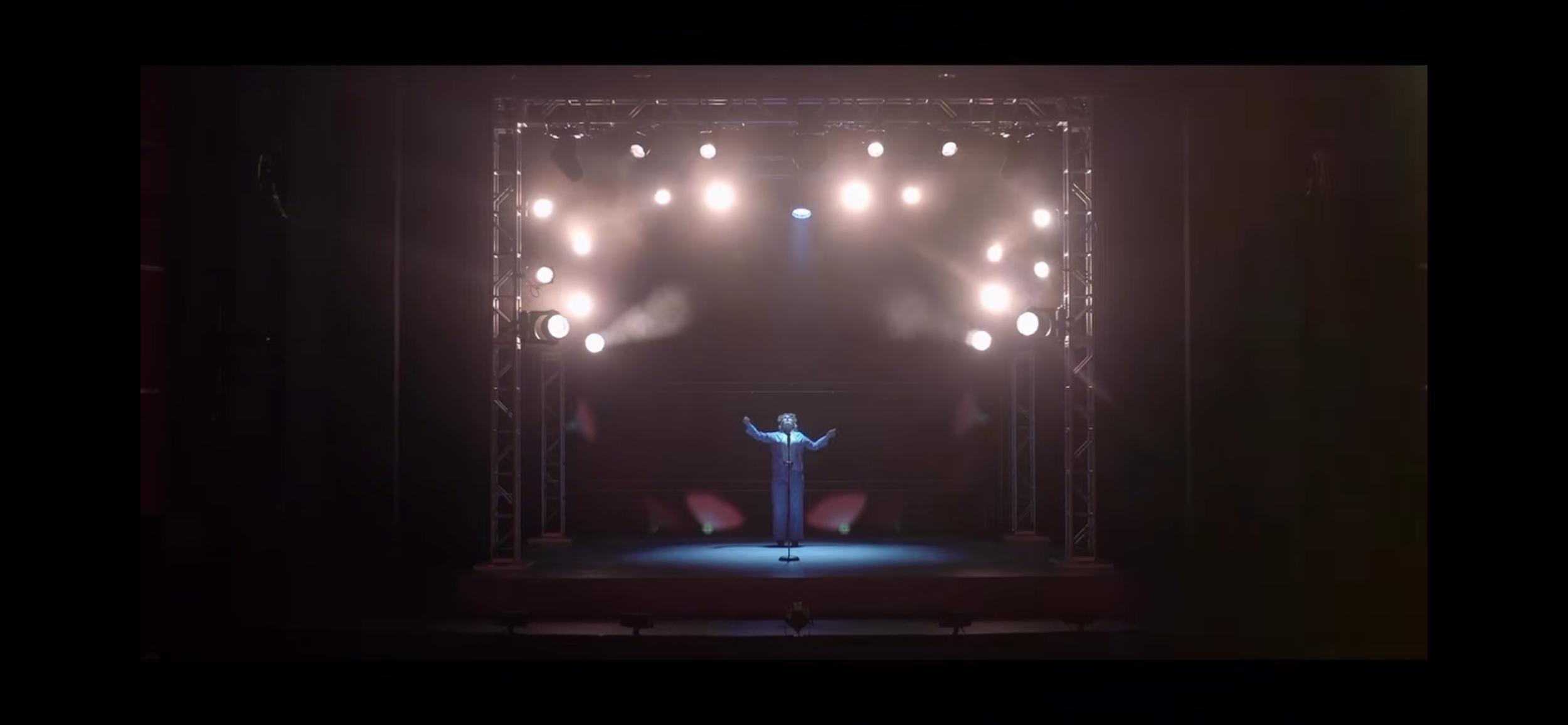
I am not sure I have ever experienced a show where nearly every single moment could have been frozen into a stunning production photo. That is not an exaggeration. The stage pictures are shaped with such clarity, and lit with such muscular theatricality, that the lighting feels like an emotional score running alongside the music. Seber’s work does not simply make the show look beautiful, though it absolutely does that. It tells us where the wound is. It tells us when the room has become memory. It tells us when a character has crossed from public performance into private rupture.
Coupled with Seth Howard’s scenic design, the entire visual world feels both deceptively simple and theatrically enormous. Behind the central box of the set is a back wall that appears, at first, to be the back wall of the theater itself. It is so unassuming that you almost stop clocking it as part of the design.
And then it moves.
When that wall began to rise and fly out of the space, exposing the band behind it in a blazing wash of light during crucial moments of the score, the audience gasped. Not a polite little theater gasp. A real one. The kind that happens before anyone has time to remember they are in public. The set itself received applause.
At intermission, I heard audience members remarking that they had never been so emotionally moved by a wall moving in their life.
And honestly? Same.
To be clear, the only reason I am writing about that moment here is because the show is, regrettably, closing this weekend. Otherwise, I would want every audience member to experience that reveal with the same shock I did. It is rare for a scenic gesture to feel not just impressive, but emotionally inevitable. That wall does not move because someone wanted a clever design moment. It moves because the world of the show can no longer contain what is trying to come through.
That is the kind of theater I trust.
Another creative element that placed this production far above much of what I have experienced recently was Sarah Parker’s choreography and the way the entire cast executed it. The movement felt raw, grounded, and alive in the bodies of the performers. It never felt pasted onto the production. It felt like something the characters could not keep inside themselves anymore.
There is a kind of choreography that announces, “Look, we are dancing now.”
This was not that.
This choreography arrived like a nervous system. It amplified emotion without translating it too neatly. It let rage, shame, desire, grief, and release move through the ensemble in ways that made the show feel physically honest. Director Michael Bello makes brilliant use of handheld microphones throughout the production, particularly during Morissette’s head-banging, pulse-forward score. When characters step into those microphones, the show shifts. We are no longer simply watching a scene unfold. We are entering a headspace. A confession. A rupture. A concert of the self.
Those shifts, paired with Seber’s lighting and Parker’s choreography, are where the production becomes most electric. The staging understands that a microphone can be an act of choice. To step up to it is to decide to be seen. Or heard. Or, sometimes, to lose control of the version of yourself you have been trying to manage.
The scenic transitions are also worth praising because they are the kind of thing an audience may only notice if they go wrong, and here, they rarely did. Furniture pieces roll on and off through a subtle ramp onto the main playing space, moved by the cast themselves with speed and intention. What struck me was how cleanly it all happened. These transitions never felt like traffic. They never pulled focus from the emotional engine of the show. Instead, they added to the sense that this ensemble was collectively building and dismantling the world in real time.
And this ensemble deserves that word: collective.
This production is so comprehensively outstanding that it feels almost unfair to single out highlights, but I must.
Monet Sabel leads the cast as Mary Jane Healy, or MJ, the mother at the center of the Healy family’s unraveling. MJ is the kind of role that could become either a villain or a victim if handled without care. She is a woman addicted to control because control has become the last language she has for survival. She is charming, brittle, loving, avoidant, wounded, and quietly dangerous in the way people can be when their pain has nowhere honest to go.
Sabel’s voice is warm and full, but when the role demands it, it pierces straight through the center of you. There is something beautifully unsettling about the way she lets MJ’s composure crack. She does not rush the unraveling. She lets us watch a woman who has spent years curating a perfect family image slowly realize that the image has become a cage for everyone inside it, including herself.
She is joined by Vera Brown as Frankie Healy, making her professional principal debut as an upcoming graduate of Webster University’s Sargent Conservatory of Theatre Arts. You would never know this was a debut of that scale. Brown carries the weight of Frankie’s role with such grace, intelligence, and fire that you would assume you were watching a seasoned professional with years of principal roles behind her. Frankie can be a difficult character because she is written with the contradictions of a young person trying to locate herself in a world that keeps asking her to explain herself before she has finished becoming. Brown never flattens those contradictions. She lets Frankie be passionate, self-righteous, tender, messy, brilliant, and young.
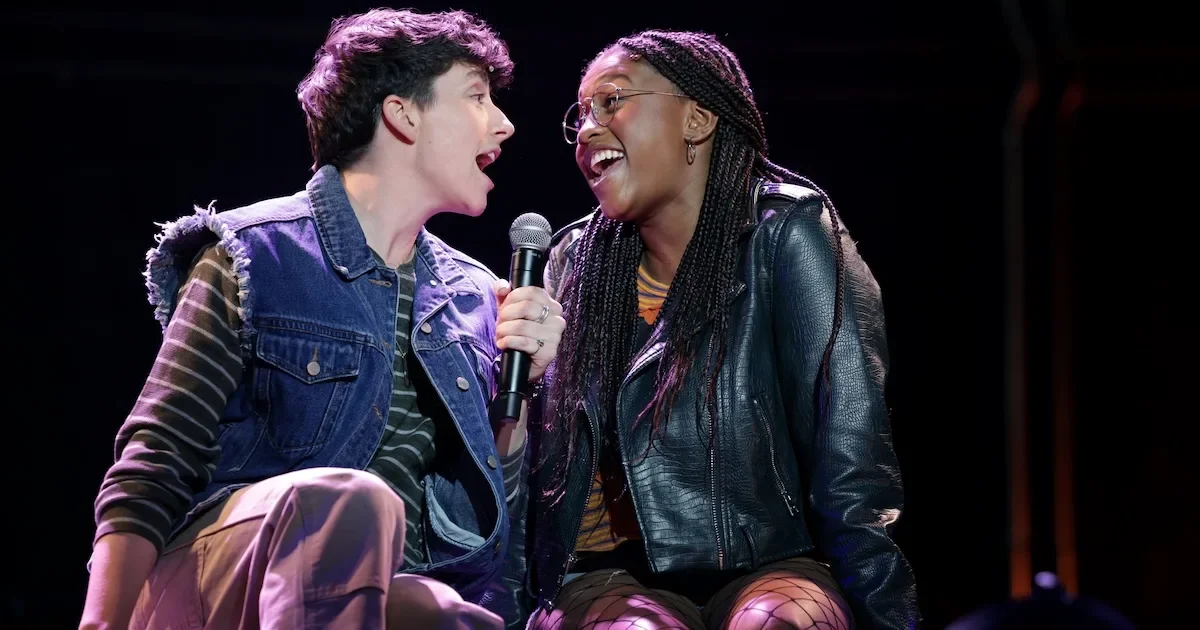
Photo by Jamie Cotten / Colorado College
And then there is Laura Leo Kelly as Jo.
I think Kelly may be my personal MVP of this production.
Jo is Frankie’s girlfriend, though even that word feels too small for the emotional weight of what they are carrying. Jo is the person left standing in the wreckage of someone else’s uncertainty. The person whose love is real, whose pain is real, whose identity is real, and yet who keeps being treated as if they are somehow negotiable.
Kelly brings such power and pain to the role, but what devastated me most was the simplicity of their acting choices. Nothing felt pushed. Nothing felt manufactured. They have the kind of presence that can make the floor drop out from under your stomach without asking for permission first. Their voice is extraordinary, yes, and we will get to that, but the voice works because the acting underneath it is so clean. So direct. So exposed.
There is an anecdote from intermission that I think says everything.
My friends and I were standing around talking about how excited we were for the second act when, all at once, we realized: “Oh my God. Jo is going to sing ‘You Oughta Know,’ aren’t they?”
We all went quiet for a second.
Then we admitted that every single one of us had goosebumps just thinking about it.
That is not because of the song alone, though obviously “You Oughta Know” is not just a song. It is a cultural event with a melody. We had goosebumps because Kelly had already done the work. Before singing one of the most iconic rage anthems of the last several decades, they had made us understand exactly whose body that rage was going to come through. By the time the moment arrived, it felt less like a performance number and more like an emotional debt finally being collected.
And yes. It delivered.
Josh Franklin brings a deeply recognizable ache to Steve Healy, allowing him to be more than the emotionally absent husband or checked-out father figure. His distance never feels empty; it feels like someone who has become fluent in not knowing what to say until silence has become its own language. Mark Autry gives Nick a beautifully pressured interior life, capturing the quiet terror of being the “successful” child in a family that has mistaken achievement for wellness. Idan Bar is pitch-perfectly cast as Bella, bringing a grounded vulnerability to a role that requires the audience to sit with the human cost of being disbelieved, dismissed, and turned into a problem other people would rather manage than face. And Antonio Porciello brings real warmth and complication to Phoenix, refusing to let him exist only as a romantic disruption. Together, they help keep the show from becoming a series of isolated explosions. They make it a family system. A web. A house where everyone has learned, in their own way, how to perform ‘being fine’. That, more than anything, is what this production understands: the tragedy is not just that people are breaking. It is that they have all been taught to break politely.
I want to be very clear, though: this entire cast, from top to bottom, is what makes the production so good. This is one of the hardest-working ensembles in contemporary jukebox musical theater. They are dancing, playing multiple characters, moving set pieces, shifting worlds, carrying microphones, and most importantly, singing the entire show with a quality of harmony that would rival any Broadway tour. I know that is a bold thing to say. I feel bold enough to say it.
The final chord of “Forgiven” that sends the show into intermission is something I would bottle and carry around with me if I could. I want to be able to open it on difficult days and let it knock the air out of me all over again.
If I were to note anything critically, and I was hunting, there were a few moments of microphone issues and a few places where I wanted a little more presence or balance from the sound. But even that feels almost unfair to emphasize, because the overall sound design by Max Silverman is doing a tremendous amount of work. The entire cast is both head-mic’d and using individual handheld microphones, which is already a feat of coordination. Beyond that, Silverman brings in sound effects and treatments that I rarely experience outside of Broadway tours: live looping elements, beautifully placed echo and reverb effects, and sonic textures that help the show move between realism, concert, confession, and psychic break.
So yes, if I am being picky, there were a few technical hiccups. But they are minor in the larger package, and the larger package is ambitious as hell.
I could also say that there were moments in the scene work where I wanted choices as bold as the singing, movement, and design language around them. A few exchanges could perhaps afford to live with more danger, more silence, more willingness to let the discomfort sit. But even as I write that, it feels like I am asking for more after being fed completely from beginning to end. So I will leave it there: in a production this brave, I occasionally wanted the text itself to be handled with the same ferocity as the music. That is not a dismissal. It is the kind of note you give when the ceiling of the work is already remarkably high.
What makes this production special is that it does not treat Jagged Little Pill like nostalgia. It does not use Alanis Morissette’s music as a shortcut to audience affection. It understands that these songs became iconic because they gave language to feelings people were told were too ugly, too loud, too inconvenient, too much.
And that is where this production connects most directly to what I want theater to be.
I am not particularly interested in theater that behaves well for the sake of being invited back into polite rooms. I am interested in theater that knows when to be beautiful and when to be rude. Theater that understands polish is meaningless if there is no pulse underneath it. Theater that can hold a perfect harmony in one hand and a live wire in the other. Theater that lets a wall fly away and reveals not just a band, but the thing we have been trying not to look at.
This production reminded me that boldness is not the same thing as volume. Sometimes boldness is a lighting shift that tells us we have entered someone’s private shame. Sometimes it is a microphone placed in someone’s hand at the exact moment they stop being able to survive quietly. Sometimes it is an ensemble moving furniture so efficiently that the world seems to rearrange itself around a wound. Sometimes it is a performer standing in the center of a song everyone thinks they know and making it feel like it was written for this body, this heartbreak, this exact second.
Colorado theater is alive. Not theoretically. Not aspirationally. Not in the way we say things are alive because we want them to be.
Alive.
Breathing, raging, sweating, harmonizing, flying walls into the rafters, and shaking the ground.
And if this weekend taught me anything, it is that the work is not happening somewhere else. It is here. It is already here. We just have to pay attention when it strikes.