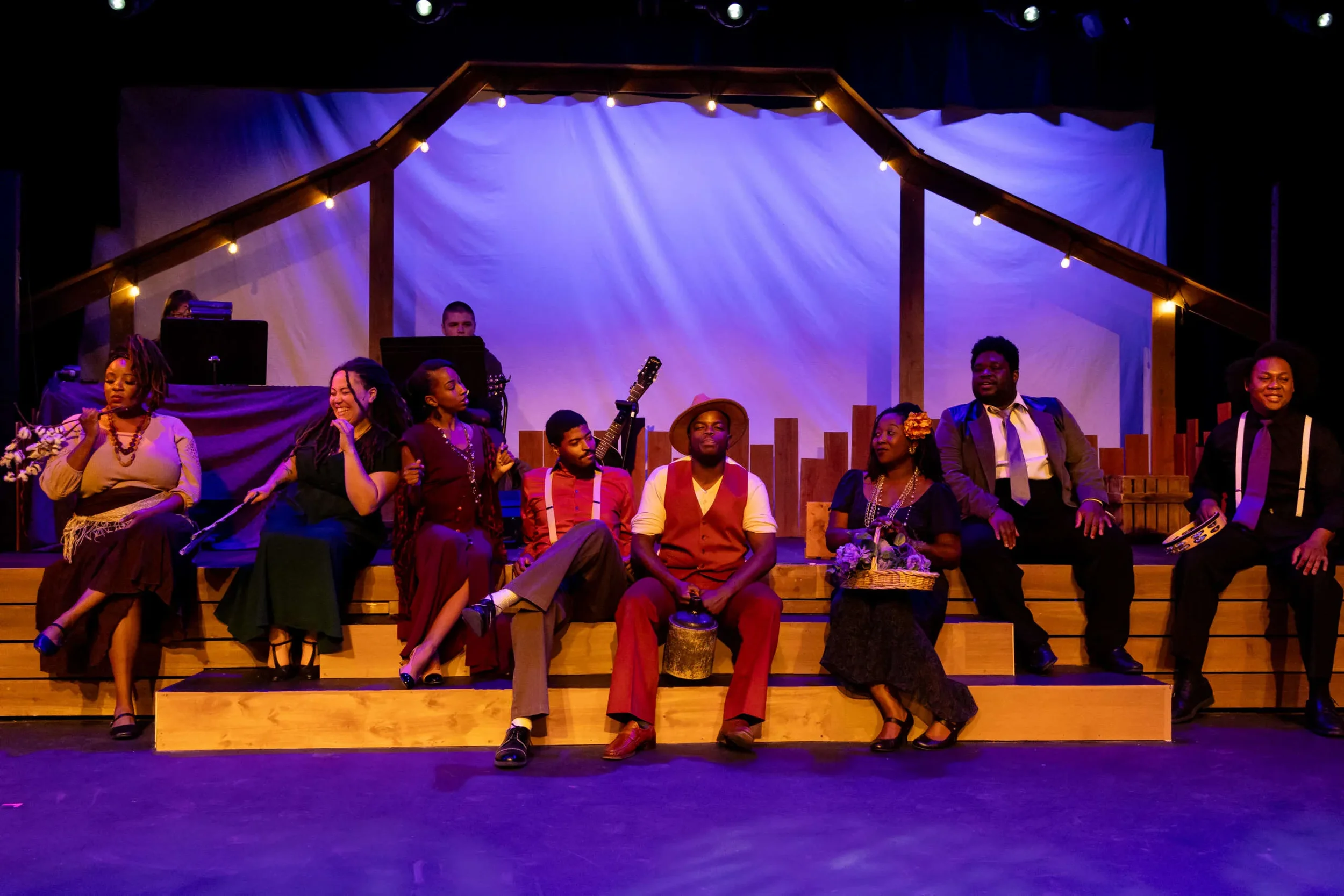
All production photos by RDG Photography
There is something quietly radical about watching an ensemble take the stage and trust music to do the storytelling.
It Ain’t Nothin’ but the Blues, now playing at Vintage Theatre Productions under the direction and choreography of Johnathan Underwood, is not a traditional musical in the way many audiences may expect. It is less plot-driven narrative and more song cycle, revue, history lesson, spiritual offering, and communal memory all at once. The book is intentionally minimal. The evening moves through the evolution of the blues rather than following a conventional story, tracing its roots from Africa to the American South and onward through Mississippi, Memphis, Chicago, and the many places where pain, survival, rhythm, and resilience became sound.
The piece itself has a fascinating history, especially for Denver audiences. Written by Charles Bevel, Lita Gaithers, Randal Myler, Ron Taylor, and Dan Wheetman, It Ain’t Nothin’ but the Blues began through Denver Center Theatre Company’s education programming in the 1990s before developing into a full-length theatrical work. It later traveled nationally, opened in New York, and ultimately transferred to Broadway, where it received Tony Award nominations including Best Musical and Best Book of a Musical. Concord Theatricals describes the show as a musical journey tracing the blues “from Africa to Mississippi to Memphis to Chicago,” with Act I moving through African celebration, the Middle Passage, plantation life, work songs, spirituals, love, disappointment, and triumph.
That structure is both the strength and, at times, the limitation of the material. The show gestures toward a theatrical framing device — a kind of journey through time and musical inheritance — but never fully develops it into a dramatic engine. There are moments when one can imagine how powerful that entry point might have been if the book leaned further into it. But that observation belongs to the material itself, not to Vintage’s production, which meets the piece on its own terms and gives it a deeply embodied, musically rich, and often stirring life.
The word I kept returning to throughout the evening was physicality.
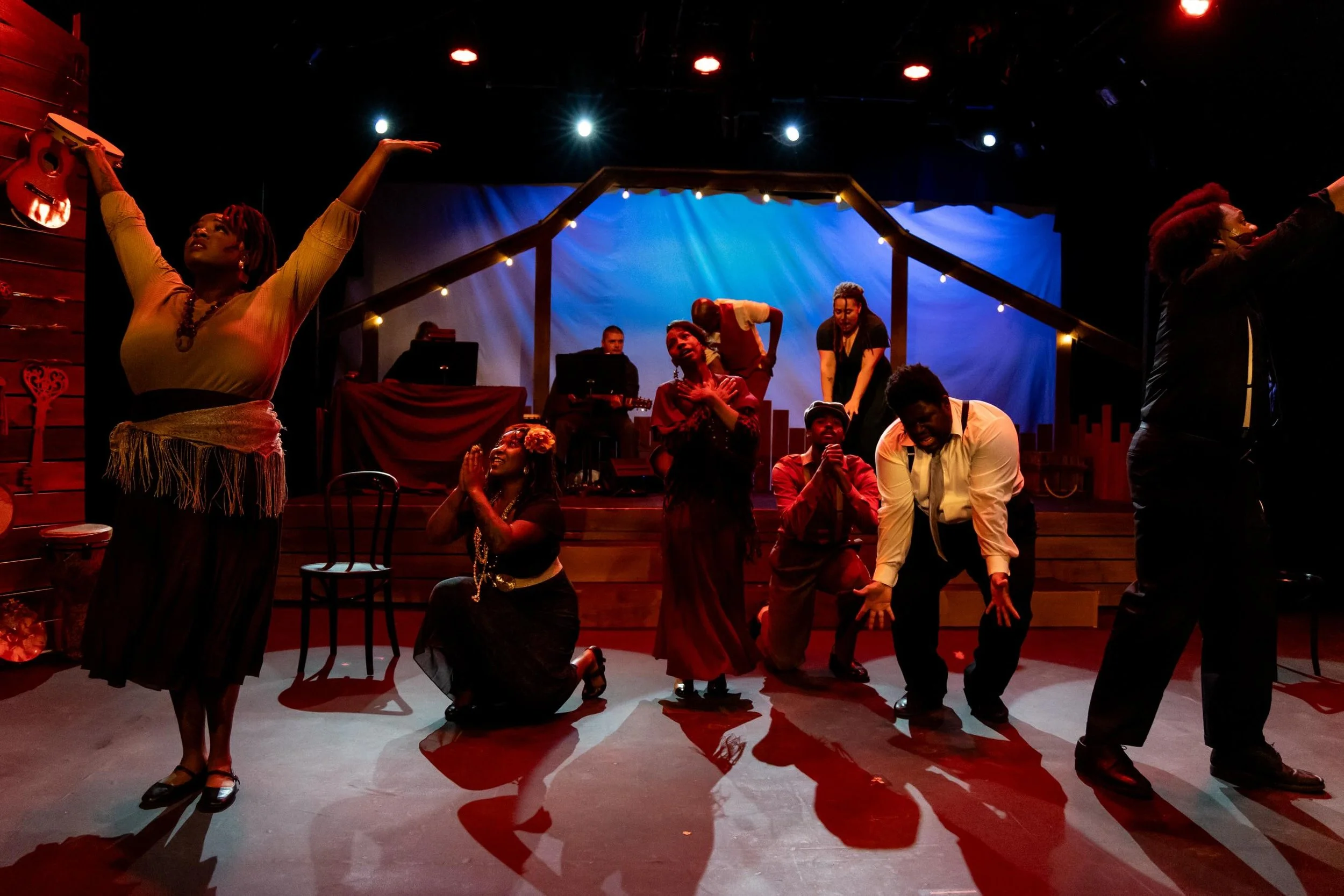
Underwood’s staging understands that the blues is not merely sung. It is carried. It is remembered in the spine, the shoulders, the hips, the hands, the breath. The ensemble is in near-constant motion, not in a way that feels busy, but in a way that feels lived in. Bodies gather, scatter, lean, reach, testify, mourn, flirt, resist, and celebrate. This production is at its best when it allows the ensemble to become a living archive — a community moving through generations of music that was born not from abstraction, but from people.
In his director’s note, Underwood writes about approaching the piece as a Black man from Memphis, Tennessee, “The Home of the Blues,” and as a queer Black artist who understands the necessity of certain stories being told by those with roots in them. He describes the show as more than a performance: a reflection of lived experience, a tribute to ancestors, and a love letter to the stories that continue to shape community. That perspective is felt throughout the production. This is not a museum piece. It is not nostalgia. It is not simply a collection of great songs. At Vintage, it feels like an act of cultural remembrance being offered with generosity to everyone in the room.
As a white, cisgender audience member, I want to be careful not to overstate my own understanding of the cultural and ancestral weight this music carries. But I can speak honestly to the experience of sitting with it. Especially from “Strange Fruit” through the second half of the evening, I found myself moved in a quieter, more complicated way. The show asks the audience to celebrate music that has shaped American culture while also sitting with the painful truth of how often that music — its sound, its language, its emotional vocabulary — has been extracted, softened, commercialized, and made more palatable when filtered through whiteness. Songs and styles born from Black experience have repeatedly been carried into mainstream popularity by white artists and industries that did not always honor the people, histories, or suffering that made them possible.
That tension matters. It is part of what makes a show like this feel important right now.
It should not feel rare to see an all-Black ensemble on a Denver stage in a work that is not being treated as obligatory “diversity programming,” trauma programming, or one of the same few titles institutions return to when they decide it is time to represent Black stories. And yet, in our current theatrical landscape, it still can. That reality is worth naming. Not because this production should be reduced to representation alone, but because the fullness of this cast — joyful, sensual, funny, sorrowful, virtuosic, communal, and completely in command — is exactly the kind of theatrical presence our stages need more of. Not as a box checked. As art. As excellence. As life.
The ensemble includes Chrisnel Akele, Atlas Drake, Kenya Mahogany Fashaw, Daja McLeod, Jozeph Mykaels, Liyah Patrick, CJ Swain, and Myles Wright, and one of the great strengths of the production is that there truly is not a weak link among them. In a more traditionally structured musical, it can be easier to isolate “leads” and “supporting” players. Here, the success of the evening depends on the company functioning as one living, breathing organism — and this cast does exactly that. They move as a community, listen as a community, and make space for one another with the kind of generosity that only works when everyone onstage is fully present.
That ensemble strength matters because It Ain’t Nothin’ but the Blues is not built around a single protagonist. The protagonist is the music. The protagonist is the lineage. The protagonist is the collective voice. Every performer contributes to that larger offering, and Vintage’s cast handles that responsibility beautifully. There are moments of humor, seduction, grief, worship, joy, and fire that pass from one performer to the next without ever losing the shared pulse of the evening.
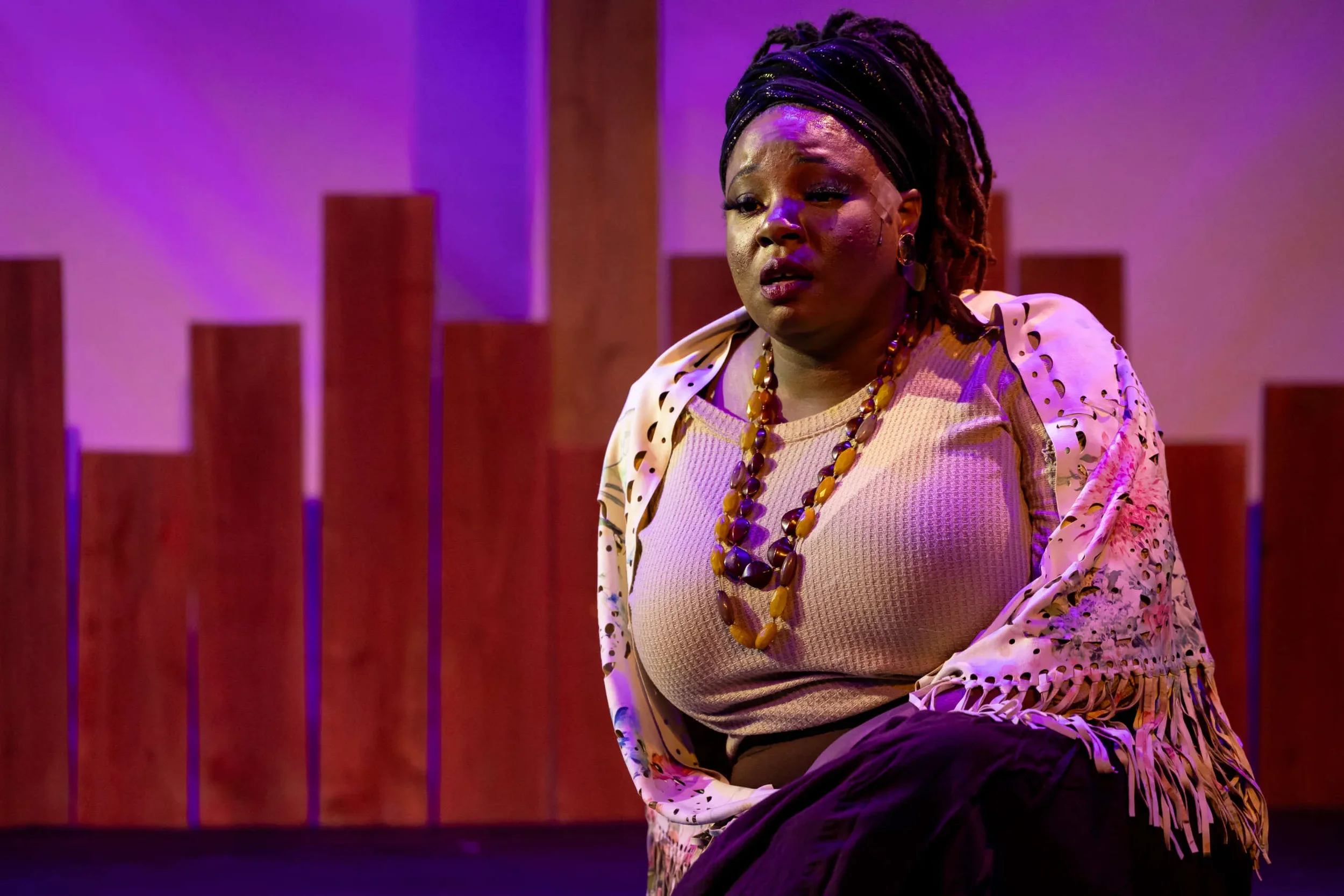
That said, Kenya Mahogany Fashaw delivers the kind of performance that makes you physically lean forward without realizing you’ve done it. Her rendition of “Strange Fruit” is devastating — not because it overplays the horror of the song, but because it trusts it. She stands inside the music with a stillness and command that feels both theatrical and deeply human. The audience response to her work was colossal, and deservedly so.
There are performers whose talent you admire, and there are performers whose humanity seems to pull you closer to the stage. Fashaw is both. She sings with power, yes, but more than that, she understands how to let a song arrive through her rather than simply be performed by her. She is vocally thrilling, emotionally precise, and completely magnetic. Whatever she does next, I want to be in the room for it. Kenya Mahogany Fashaw is, quite simply, a queen.
Liyah Patrick also deserves special recognition. I had the joy of sharing the stage with her this past summer in Bare: A Pop Opera, where she played Sr. Chantelle, and I already knew her as a warm, grounded, generous presence. But watching her in this production felt like hearing her voice for the first time all over again. In numbers like “My Man Rocks Me” and throughout the evening, Patrick revealed a vocal richness and command that felt both surprising and completely inevitable. There is a looseness, confidence, and lived-in musicality to her work here that allows her to step forward without ever pulling focus from the ensemble. She is deeply, deeply good.
The music direction and band are equally essential to the evening’s success. Jeremiah Otto’s work on keys provides the production with a strong and sensitive foundation, supporting the singers with clarity, texture, and restraint. But AbdulKarim Islam deserves more than a passing mention; he is one of the undeniable forces of the evening. His musicianship is not merely accompaniment — it is storytelling.
Islam moves between djembe, harmonica, guitar, and seemingly every stringed possibility available to him with astonishing ease. His playing has grit, soul, precision, heat, and an almost dangerous charisma. There is something electric about watching a musician so completely in command of his craft that the instrument feels less like something he is playing and more like an extension of his body. His work does not sit behind the production. It breathes inside it. He deepens the mood, sharpens the transitions, answers the singers, and helps carry the ancestral and emotional weight of the entire evening. In a show built around the power of music as memory, AbdulKarim Islam is invaluable.
The production design is simple, and for the most part, appropriately so. The set does not attempt to compete with the music or the bodies onstage. It provides a clean, functional space for the ensemble to move through the many worlds the show evokes. The lighting offers some strong and atmospheric choices, particularly in numbers like “Fever,” where the design finds a more specific visual language. At other moments, however, the lighting feels more practical than expressive. It supports the action clearly, but does not always deepen or complicate the emotional landscape in the way the music and movement are already doing.
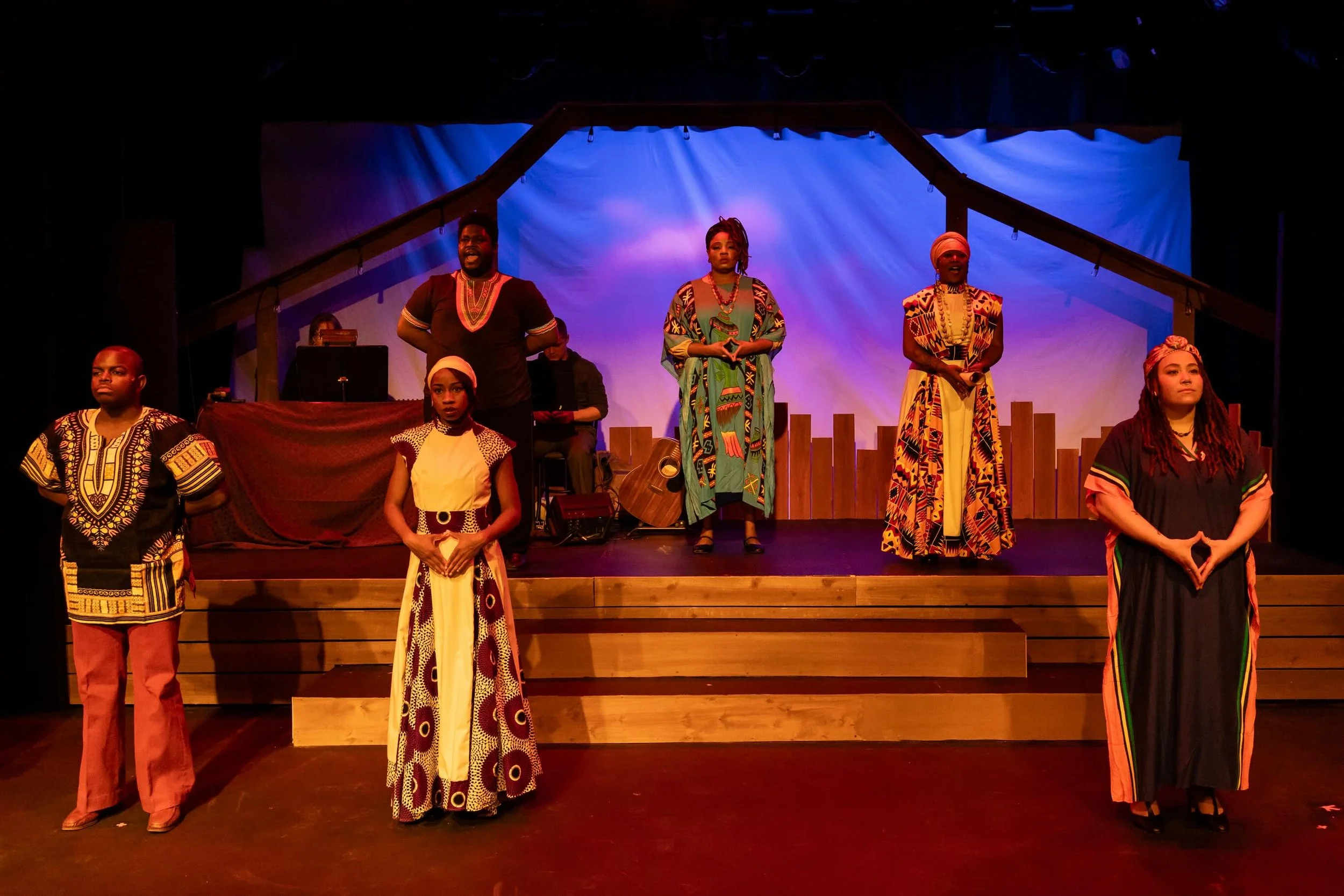
The costumes, however, are quietly beautiful. Apart from the glorious African traditional garments that open the show, the production stays within a consistent visual world of burgundy, burnt orange, brown, green, and earth-toned textures. The palette is warm, grounded, and deeply appealing to the eye. More importantly, the costumes feel personal. Each look seems like something the performer might have chosen for themselves for an evening of celebration, gathering, testimony, and song. That choice helps the production feel less presentational and more communal.
One of the most moving parts of the evening happened after the curtain call. Standing outside the theatre, I heard audience members — many of them older white patrons — talking with genuine enthusiasm. “We have to buy tickets for the girls; they would love this.” “This was the best show of the season.” Those comments stayed with me. Not because the show needs validation from any particular demographic, but because there was something beautiful about watching this work land. There was something hopeful about seeing an audience receive it not as homework, not as obligation, but as a thrilling and meaningful night of theatre.
And that may be where Vintage’s production succeeds most.
It Ain’t Nothin’ but the Blues is not a perfect piece of theatre. Its structure can feel more like a concert journey than a fully realized dramatic arc, and some of its most compelling theatrical ideas remain underdeveloped in the writing. But when performed with this much conviction, movement, musicality, and love, those limitations become secondary to the experience of the room.
Johnathan Underwood’s production understands that the blues is not simply sadness. It is survival. It is humor. It is sensuality. It is protest. It is memory. It is the sound of people looking forward even when history has given them every reason not to.
At Vintage Theatre, It Ain’t Nothin’ but the Blues becomes exactly what Underwood hoped for in his note: a massive hug from the South, a celebration, a reflection, and a reminder that some music does not merely entertain us. It tells us where we have been, who we have harmed, who we have ignored, who we have learned from, and who we still have a responsibility to hear.