All Production Photography captured by Jamie Kraus Photography
I want to start this by recognizing that I am not your typical reviewer.
I started my theater career at 5 years old, dancing with the Boston Liturgical Dance Company. We don’t have to talk about that. Or we can, but it’s a different article and probably requires a glass of wine.
From there, I was deeply involved in theater as a child. I played Mamillius in The Winter’s Tale, which is the best Shakespeare play of all time, and I won’t be taking questions at this time. I went on to play a child servant in the home of Helen Keller in The Miracle Worker, which was a different time; again, we don’t need to get into it. Then I spent six years studying Chekhov and Ibsen with Elements Theatre Company, a classics-based theater company out of Massachusetts, where I got to play Demetrius in A Midsummer Night’s Dream, roles in Twelfth Night, Hal in Proof, and so on.
But none of that is really the point.
Eventually, I went to Temple University, where I was accepted into both the Musical Theater and Acting concentrations. So yes, I have opinions. But more importantly, I have spent most of my life trying to understand what makes theater work.
Here’s the thing. Theater is my life. It is my everything.
I may not be what people expect from a critic, but I’m also not trying to be. I’m a peer. I’m an artist. I’m a director, a performer, a producer, and someone who is trying very earnestly to create alongside the greats for the rest of my career. So when I write about theater, I’m not writing from some detached tower of taste. I’m writing from inside the thing. I’m writing as someone who has spent most of his life trying to understand why a body moving through space, a family sitting in a room, or a single line spoken truthfully can rearrange something inside us.
I think I watch theater by looking for the places where performance stops being decorative and starts becoming necessary. Maybe that comes from being raised in a world where performance was survival. Maybe it comes from drag, where the artificial can sometimes tell the truth more cleanly than realism ever could. Maybe it comes from pageantry, where every gesture is supposed to look effortless even when the seams are screaming underneath. Whatever the reason, I am always watching for the moment when craft becomes confession. When blocking becomes psychological. When a costume stops being period-accurate and starts telling me what someone is trying to protect.
That’s why I’m doing this.
I want to start putting into words what my experiences with theater actually are. Not just whether something was “good” or “bad,” which increasingly feels like the least interesting way to talk about art, but what I learned from it. What it revealed. What it asked of me. What it revealed. What it reminded me I still believe.
Am I also doing this to bring people to my website, build attention around Other Road Theater Project, and start making a name for myself and the company? Yes. Yes, I am.
But if Other Road is going to mean anything, it cannot just be a logo on a website or a season announcement with good font choices. It has to be a way of looking. A commitment to asking what changes when we move the center of the story. Who has been treated like context? Who has been mistaken for scenery. Who has been asked to make themselves smaller so someone else’s dream could look inevitable?
But none of that really matters because I decided all of this the same afternoon I went to see Somewhere at the Denver Center for the Performing Arts.
Is it ironic that this new little personal experiment in writing about theater began on the same day I saw one of the most complete and affecting pieces of theater I have seen in Colorado since moving here in December of 2017?
Yes.
Is it also maybe exactly the kind of thing theater people would call “meant to be” while pretending we don’t believe in signs?
Also yes.
And then the play itself seemed to answer the exact question I had been asking: what does theater become when someone’s personal history is placed inside a larger American myth?
Somewhere, written by Matthew López, takes place in 1959 in the San Juan Hill neighborhood of Manhattan, at the moment when West Side Story is the biggest thing on Broadway and the film adaptation is about to begin shooting. The play follows the Candelarias, a Puerto Rican family living in a small apartment and chasing show business dreams while their neighborhood is being demolished to make way for Lincoln Center. In other words, it is a play about dreams, yes, but also about who gets to dream without being punished for it. That question hit me harder than I expected. I know what it feels like to grow up inside a world that tells you your dreams are only acceptable if they can be made useful to the structure around you. I know what it feels like to have your imagination treated as a threat before you even have language for why.
The play premiered at The Old Globe in San Diego in 2011 and later received a production at TheatreWorks in 2013. López has spoken about how the piece connects to his own family history, including his father’s experience as an extra in the 1961 film version of West Side Story. That biographical detail matters because Somewhere never feels like a detached historical exercise. It feels like a memory. It feels like an inheritance. It feels like someone holding a family story up to the light and asking what else history tried to erase around it.
There are moments when the play’s sentimentality could easily tip into something too neat, especially given how directly it engages dreams, family, and theatrical longing. But in this production, that sentimentality is not avoided. It is earned.
And where to begin with this particular production?
I think the best place to start is the experience of walking into the Kilstrom Theatre.
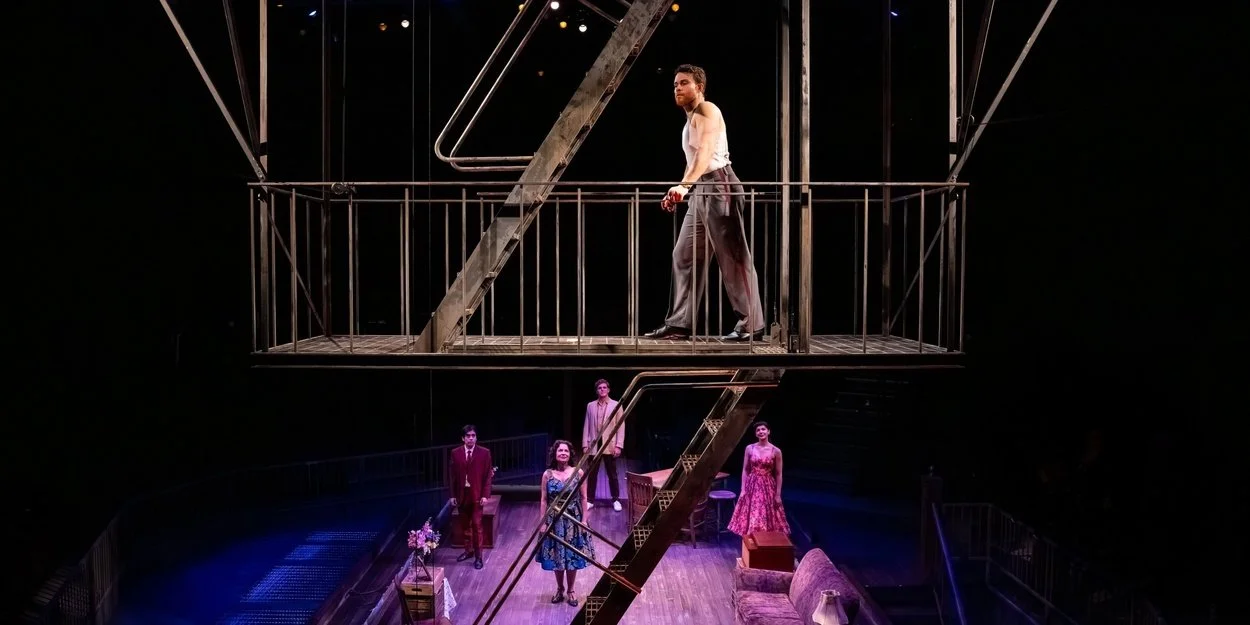
Efren Delgadillo, Jr.’s scenic design is somehow both simple and monumental. A fire escape hangs suspended above the space, descending below the deck into what becomes the basement, creating a vertical world that immediately tells us this family is living inside layers: above and below, public and private, dream and survival. The partial walls around the apartment are minimal, but they still feel like they are closing in. They don’t need to be fully built to be oppressive. They suggest the shape of a home while constantly reminding us how precarious that home is.
Pablo Santiago’s lighting design deserves its own praise, especially because it is so quietly ingrained into the production that I almost forgot to name how much it was doing. The lighting never feels like it is announcing itself, which is exactly why it works. It guides the eye with incredible precision, helping us understand where to look in a space that constantly asks us to watch multiple lives unfolding at once. But it also does something more delicate. It lets us know when we have slipped out of the room and into the mind, memory, or dream life of the characters. The shifts are simple, but they are deeply theatrical. A change in light becomes a change in reality. A softer edge becomes an invitation into longing. Santiago’s work understands that the play is about people trying to force the world to look like their dreams. And it permits them to do so.
Because the audience surrounds the playing space, we are never allowed to watch from a comfortable distance. At times, the staging makes the Candelarias feel pinned, observed, almost like animals in a cage, and I don’t mean that lightly. There is something intentionally uncomfortable about the way we are asked to watch them fight for joy, privacy, dignity, and space. The production understands that spectatorship is not neutral. And while this current moment may make some audiences more alert to that conversation, the play refuses to let us pretend these injustices are new. The machinery has always been there. The names change. The language gets polished. The displacement gets rebranded. But the question underneath remains the same: whose life gets interrupted so someone else can call it progress?
That is part of what makes Somewhere feel so immediate.
Yes, this is a play set in 1959. Yes, it is about San Juan Hill. Yes, it is about the construction of Lincoln Center and the human cost buried under the language of progress. DCPA notes that roughly 7,000 people were displaced by the construction of Lincoln Center, and that San Juan Hill was home to major Black and Puerto Rican communities before it was demolished. But if the play only lived in the past, it would be easier to admire. It does not let us do that.
We are watching this story in a political moment where immigrant communities are being discussed, legislated, targeted, romanticized, defended, flattened, and weaponized all at once. And while the current administration has forced more people to pay attention to these conversations, the truth is that the challenges, indignities, and injustices faced by immigrant families and families treated as immigrant families have always been here. The play makes that painfully clear. It reminds us that displacement rarely announces itself as cruelty. More often, it calls itself progress. Development. Opportunity. Renewal.
And then the question becomes, opportunity for whom?
Matthew López has said that he did not set out specifically to write a play about gentrification, but that the play asks the audience to consider what progress costs and who pays for it. That question hangs over every inch of this production. It is in the walls. It is in the floor. It is in the bodies of the actors. It is in the dancing.
The first character we meet is Alejandro, the eldest son, played by Ángel Lozada. Alejandro is the anchor of the family, and Lozada’s performance is, without exaggeration, transcendent.
What makes his work so powerful is how much he reveals by refusing to reveal it all at once. This is a performance built as much out of restraint as expression. Lozada understands the exhaustion of being the responsible one. The one who has had to defer. The one who has had to become practical because someone had to. The one whose dreams did not disappear, but got folded carefully and painfully into the corner of his own life.
There are moments when you may not be looking directly at him, and that is exactly when he breaks your heart. A glance. A shift in posture. The way his body seems to remember movement before he permits himself to move. Alejandro is not a man without dreams. He is a man who has had to ration them. That is one of the things I found most devastating about him. He does not lack imagination. He has simply learned the cost of letting people see it.
And then there is the line that sits at the heart of the piece: “We are a family of dreamers. We force the world to look like our dreams. We do not force our dreams to look like the world.”
Lozada’s power is met and balanced beautifully by Adriana Sevan as Inez, the family’s mother. Sevan is rooted, grounded, passionate, funny, sharp, and entirely human. She gives Inez a sass and theatricality that never once slips into caricature. You believe this woman has carried more than anyone should have to carry, and you also believe she has chosen joy over and over again with the stubbornness of someone who knows joy is a form of survival.
There were moments in Act II when Sevan had me crying, and I am not entirely sure those moments were “supposed” to make me cry. That is one of my favorite things an actor can do. Not manipulate emotion, but unlock something adjacent to it. In particular, the scene where Inez speaks about meeting her absentee husband, Pepe, who remains central to the story without ever being physically present, is devastating in its simplicity. Or maybe he matters so much because he is absent. The space he leaves behind becomes one of the most important characters in the room. I think I am always moved by women like Inez because they understand something theater understands too: absence still has blocking. The people who leave still shape the room.
Danny Gómez as Francisco brings a brilliant, electric balance to the family. His energy is playful, immediate, and alive in a way that makes the apartment feel fuller whenever he enters it. He gives Francisco the kind of charm that could easily become surface-level, but Gómez keeps finding the ache underneath. He understands that youthful exuberance is often a cover for fear, and that sometimes the loudest person in the room is the one trying hardest not to hear what is coming.
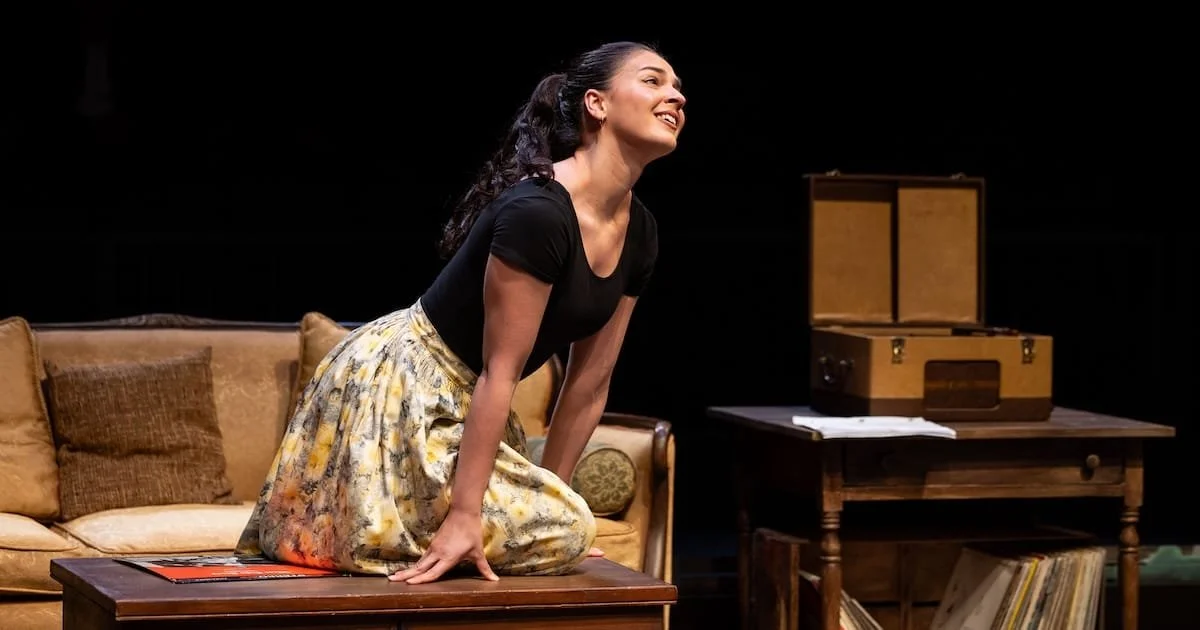
Bella Serrano’s Rebecca brings the fierce desire and passion that feels iconic to this family. Rebecca is not simply “the girl with a dream.” She is a young woman beginning to understand that the world may have a smaller imagination for her than she has for herself, and Serrano lets us see both the fire and the fragility in that realization. Her work has a brightness to it, but not a shallow one. It is the brightness of someone reaching for a future she can almost see.
Keaton Miller’s Jamie is a beautiful addition to the family dynamic, bringing humor, warmth, and a kind of watchful innocence that helps widen the emotional world of the play. Jamie could easily exist only as relief, but Miller gives him specificity: the kind of young person who is still soft enough to be funny, but old enough to understand that the adults around him are carrying things they cannot fully explain.
And then there is the choreography.
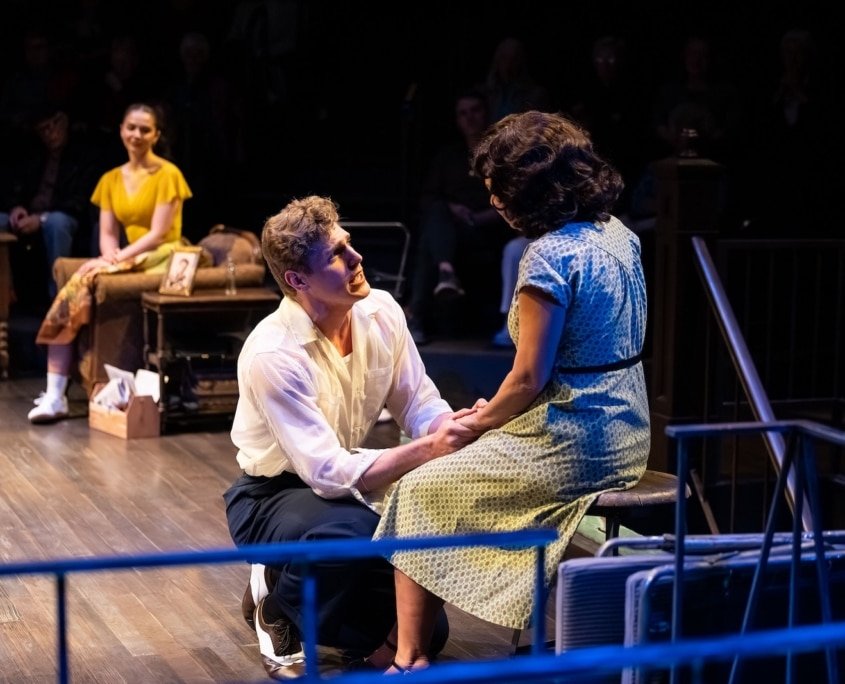
Mayte Natalio’s work is subtle, smart, and deeply moving. It references the world of Jerome Robbins and West Side Story without turning into imitation or quotation marks. The choreography feels like it lives inside the bodies of the actors before it ever becomes “dance.” That distinction matters. These are not dance breaks imposed on a play. These are eruptions of inner life. The movement arrives because language is no longer enough. That is the kind of choreography I trust most. Not movement that asks to be admired from the outside, but movement that feels like it has been waiting inside the body for permission. As someone whose first language in theater was dance, I felt that deeply. The body always tells on us. Sometimes, before we are ready.
That may be one of the production’s greatest achievements. It understands that dance can be memory. Dance can be longing. Dance can be inherited. Dance can be the version of the self that survives even when the world keeps trying to make you smaller.
Kevin Copenhaver’s costume design is equally intelligent. There are moments when the clothes feel so natural you almost don’t notice them, which is often the highest compliment for period costume design. The clothing belongs to these people. It supports the world without announcing itself. But as someone who has spent a not-insignificant amount of his life thinking about what a dress can do before anyone says a word, I also noticed the moments when costume became aspiration. A silhouette. A color. A shape that says, “This is who I am trying to become.” And yes, every so often, there was a dress that made me think, “God, I’d kill for that.”
Laurie Woolery’s direction holds all of this together with extraordinary care. The production never loses sight of the family at its center. Even when the historical and political implications of the play expand outward, Woolery keeps returning us to the apartment, to the kitchen-table stakes, to the very human question of what happens when the world asks you to sacrifice your home, your body, your art, or your future in exchange for someone else’s idea of progress.
That is what makes the final moments land so hard.
It has been a minute since I sat in a theater where the final blackout happened, and the row in front of me immediately started whispering, “Wow. Oh my God.”
And I was saying the same thing.
It has been a minute since I have seen theater feel this immediate in Colorado. I left profoundly moved, and also reminded of why I have always had a particular reverence for straight plays. Not because musicals can’t move me. They can. Obviously. I am not a monster. But because there is something about realism, when done at this level, that feels almost dangerous. It doesn’t ask us to escape the world. It asks us to look harder at it.
This is the kind of theater I want to chase. Not because every play needs to be realistic. Not because every production needs to be political in the obvious sense. But because theater, at its best, makes the invisible architecture visible. The family rules. The social contracts. The rooms we inherit. The dreams we are allowed to say out loud and the ones we learn to hide in our bodies.
And when realism can change the world, let it.