All Photo Credit: RDG Photography
There is a very particular danger in reviving Avenue Q in 2026.
Not because the show is shocking. In many ways, it is probably less shocking now than it was when it first arrived. Not because the jokes all land exactly the same way they did twenty years ago. They don’t. And not because the show has somehow become a pristine artifact of early-2000s musical theater that should be handled with white gloves and reverence. It absolutely has not.
The danger is actually much more interesting than that: Avenue Q asks a modern audience to loosen its grip.
And Town Hall Arts Center’s production, now heading into its closing weekend, understands that the best argument for this show is not to defend every joke, apologize for every edge, or underline every lesson until the whole thing collapses under the weight of its own self-awareness. Instead, this production seems to look out at the audience and say, with a felt hand on our shoulder: hey, it’s really not that serious. Calm down.
That may sound dismissive, but in practice, it feels surprisingly generous.
Avenue Q, with music and lyrics by Robert Lopez and Jeff Marx and book by Jeff Whitty, opened on Broadway in 2003 after its Vineyard Theatre run and went on to win the 2004 Tony Award for Best Musical, along with Best Book and Best Score. It was the scrappy, filthy, puppet-filled little engine that could, and its win over Wicked has remained one of the more memorable Tony stories of the modern era. The show ran more than 2,500 performances on Broadway before closing in 2009, which says a lot about how deeply its absurd little block of New York real estate tapped into something real.
On paper, the premise is still beautifully simple. Princeton, a recent college graduate, arrives in a neighborhood he can actually afford and immediately begins the terrifying business of becoming a person. He wants purpose. He wants love. He wants a job. He wants to be special. He wants all the things we were told would arrive if we did life correctly, only to discover that adulthood is mostly a series of strange compromises made while paying rent. Town Hall’s own production description frames the show around Princeton navigating “love, work, and purpose” in a New York neighborhood filled with puppets and humans, and that really is the spine of the piece.
What has changed is the room around the show.
When Avenue Q first hit, part of the thrill was the collision of children’s television vocabulary with adult panic. The show used the visual language of educational programming to sing about racism, porn, sexuality, unemployment, loneliness, and the vague humiliation of having a bachelor’s degree and no clue what to do next. In 2026, audiences are not exactly unaccustomed to adult cartoons, internet filth, or cheerful songs about emotional collapse. We are, however, very accustomed to taking the temperature of every joke before we laugh.
That is where this production finds its sweet spot. It does not make Avenue Q feel harmless, because harmless would be boring. It also does not push the material like it needs to prove it still has teeth. Instead, it lets the show be what it has always been at its best: rude, ridiculous, occasionally uncomfortable, and far more sincere than it has any business being.
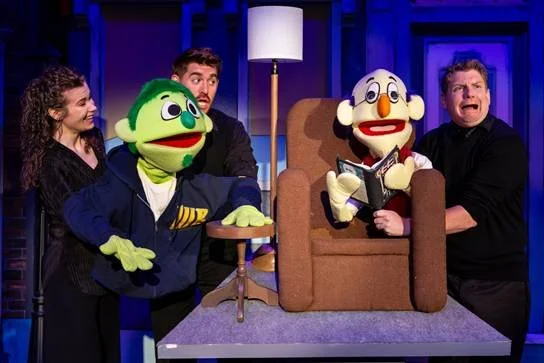
The first thing that struck me while watching this cast was how hard they are working. Not “musical theater is hard” hard, though of course it is. I mean this specific production requires a kind of full-body, full-brain choreography that becomes its own backstage ballet happening in plain sight. Actors are constantly trading puppet tracks, assisting one another on two-person puppets, voicing one character while physically supporting another, and sometimes concealing the vocal performance of one (or more characters on stage) so another can take focus.
That sounds technical because it is technical. But what makes it thrilling is how invisible the difficulty becomes.
There were several moments where I caught myself looking past the humans entirely and focusing on the puppets as if they had simply become alive. That does not happen by accident. It is a credit to the cast, puppetry captain Fiona Wohlfarth, puppetry coach Katy Williams, and the whole creative team that the puppets never feel like props being held up for our approval. They breathe. They listen. They react. Their little felt arms somehow have timing, attitude, and emotional opinion.
And when multiple performers are operating the same puppet, the coordination is genuinely impressive. One arm matches the other. A gesture lands with the same thought behind it. The audience may not consciously track the amount of labor happening, but the result is unmistakable: the puppets have lives.
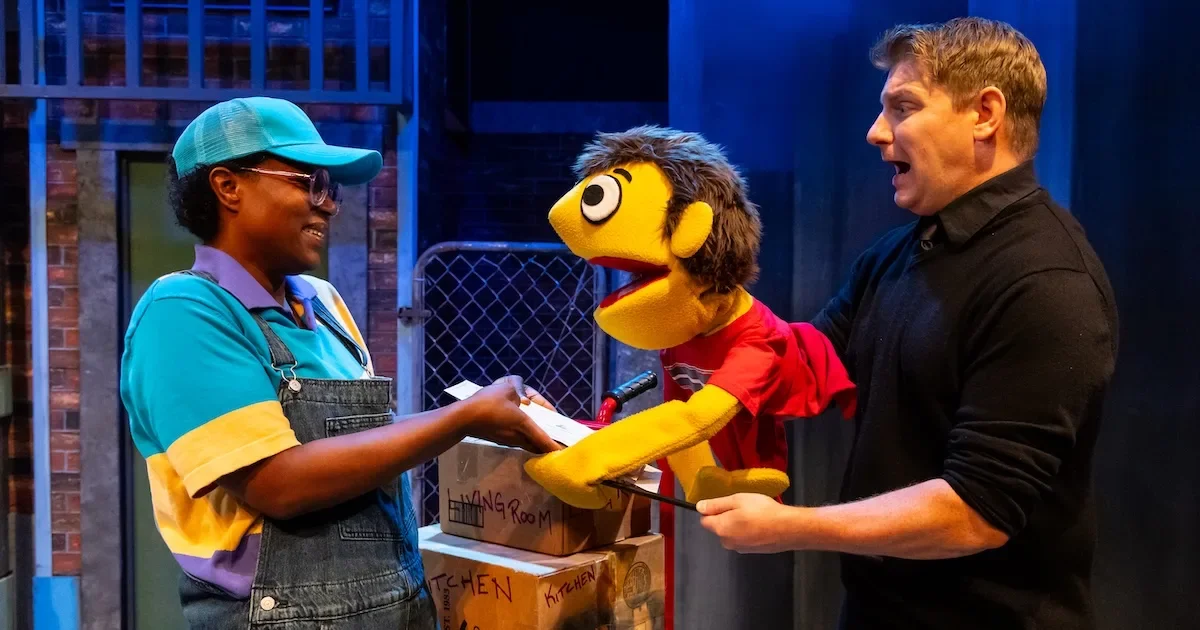
Tim Howard is a wonderfully grounded Princeton and a sharply drawn Rod, two roles that require wildly different engines. His Princeton has the exact right brand of anxious optimism, the kind of person who is trying very hard to believe he is on the verge of becoming who he is supposed to be. As Rod, Howard shifts into a tighter, more controlled comic language without losing the character’s vulnerability. The transitions between the two are fast, clean, and often funnier because he does not overplay the difference. He trusts the audience to follow him.
Asya Toney’s Gary Coleman is an absolute delight. The role itself can be a tricky piece of the show’s early-2000s machinery, but Toney plays it with such buoyancy, warmth, and perfectly tuned dark humor that the joke never curdles into something cruel. There is a real intelligence to the performance. Toney lets us in on the joke without ever asking us to laugh at the character. That distinction matters, and she gets it exactly right.
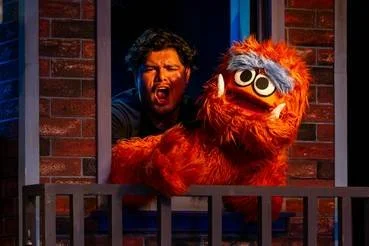
Brandon Guzmán brings huge, gleeful energy to Trekkie Monster, and the production is better for every time he appears. Trekkie is a character who can easily become one volume, one bit, one gravelly punchline. Guzmán gives him the required outrageousness, yes, but also a kind of shameless, joyful largeness that feels infectious rather than mechanical. He knows how to ride the ridiculousness without flattening it.
And then: Cass Dunn.
Dunn’s double track as Kate Monster and Lucy the Slut is one of the production’s clearest showcases of just how deceptively difficult this show is. Kate needs sincerity without becoming precious. Lucy needs confidence without becoming a cartoon of a cartoon. Dunn makes the shift look almost unfairly easy. Their Kate is open-hearted and immediately likable, but never soft in a way that makes her boring. Their Lucy has bite, sparkle, and comic danger, but still feels fully performed rather than simply indicated. It is a deeply funny, deeply controlled performance hiding inside what looks like play.
Patrick J. Clarke also deserves real credit for the athleticism and specificity of his work as Nicky and one of the Bad Idea Bears. Like Dunn, Clarke is carrying a deceptively demanding track that asks him to move in and out of different comic rhythms while remaining generous inside the larger puppet vocabulary of the production. His Nicky has a loose, affectionate charm that plays beautifully against Rod’s repression, and his Bad Idea Bear work lands with the exact kind of bright-eyed menace that makes those characters so stupidly effective.
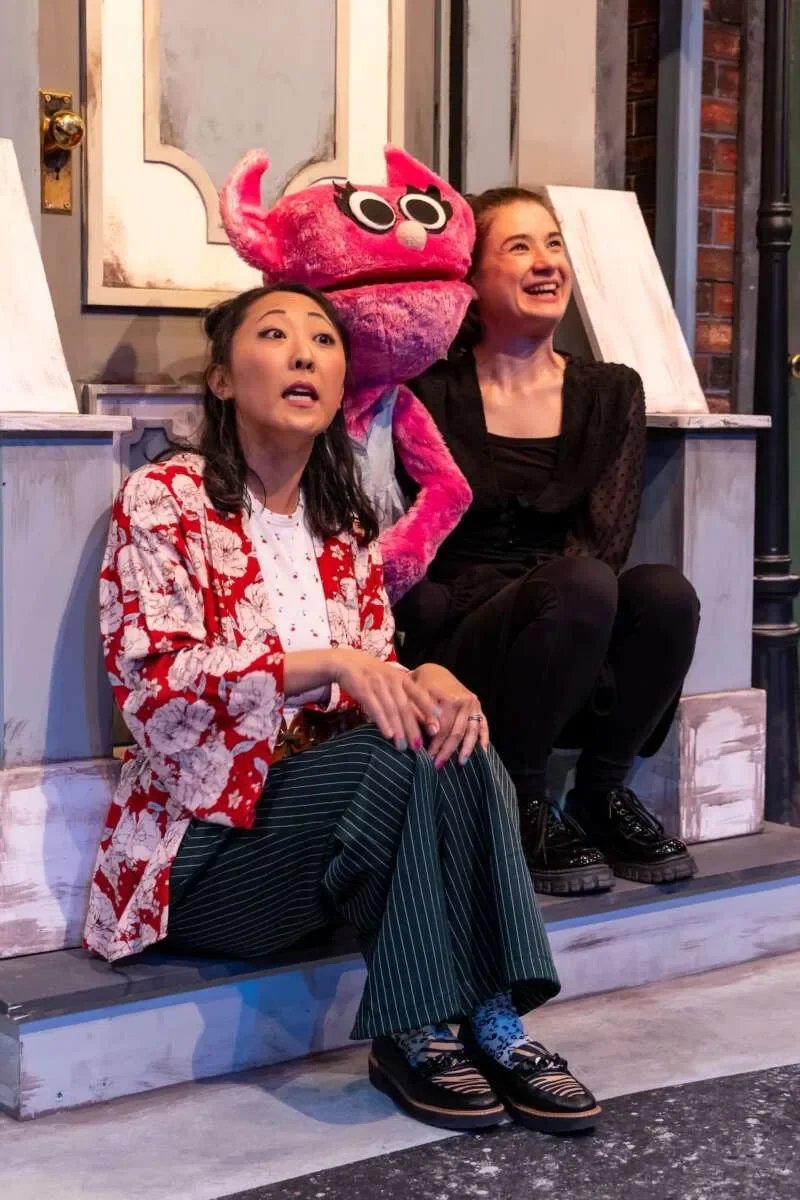
Kim Egan’s Christmas Eve brings another complicated piece of the show into focus. It is no secret that Christmas Eve is one of the roles most clearly marked by the era in which Avenue Q was written. Egan does not solve that by pretending the writing is not what it is. Instead, she commits to the character’s bluntness, force, and comic certainty, and she finds the fun in someone who says the quiet part loudly because she has no interest in everyone else’s delicate little evasions. Her presence gives the show a welcome jolt whenever she enters.
The ensemble as a whole deserves more praise than a standard cast list can really capture. Adam Rojas, Christina Smith, Christopher Norwood, Coire Geare, Fiona Wohlfarth, John Boggs, Junelle Gabrielle Flores, Jysten Atom, Marlo Coffin, TaNayyah Bryels, and Zach Stailey are all part of the reason the evening moves with such precision. This is the kind of show where support work is not secondary work. The people assisting, swinging, playing, tracking, operating, and listening are often the invisible structure holding the whole thing together.
That same sense of thoughtful construction carries into the design.
Curt Behm’s scenic design creates a strong, immersive home base for the characters and puppets to inhabit. The Avenue Q street itself gives the production an immediate visual identity without overcomplicating the playing space. But the design is especially clever in the way smaller scenic pieces move through the world. The beds for Nicky and Rod, the Empire State Building observation deck, and other rolling units are simple in the best theatrical sense: they tell the audience exactly where we are without trying to build the entire room for us.
There is also a playful perspective to those pieces that makes them feel almost like we are seeing the world through puppet logic. The beds, for instance, have a kind of upright storybook quality to them, as though the audience’s mind completes the room before the set ever has to. It is a smart choice for a show that lives between human realism and felt absurdity.
Kacy Rouse’s props and Cory Gilstrap’s puppet design naturally sit close to the center of the production’s visual success. The puppets are expressive, specific, and durable enough to withstand a production that asks a great deal of them. They are funny before they speak, but not so visually busy that they overwhelm the actors using them. That balance is harder than it looks.
Emily A. Maddox’s lighting design supports the production with clarity and color, using texture and shift without pulling attention away from the performers. The lighting does not need to scream for focus here, and wisely, it does not. It helps the world feel animated, bright, and theatrical while still allowing the puppets to remain the most expressive objects in the room.
I also loved the way the band was handled visually. Zach Stailey leads a rock-solid group of musicians, concealed behind a skyline scrim wall that becomes its own quiet design moment. When the lights drop and the music stand lights glow behind the city, we get these little glimpses of the band inside the world of the show rather than outside it. It is a small detail, but a deeply satisfying one. The music never feels detached from the neighborhood. It feels like Avenue Q has a heartbeat behind the buildings.
Director Matthew Kepler has shaped a production that trusts the material without worshipping it. That feels like the right move. Avenue Q does not need to be treated like a sacred text, and it does not need to be dragged into the present by force. It needs rhythm. It needs clarity. It needs performers who understand that the show’s bad behavior only works when the heart is real.
Town Hall has found that heart.
There are jokes in Avenue Q that land differently now. There are moments that make you aware of the distance between 2003 and 2026. But honestly, that distance may be part of what makes the show interesting to revisit. It gives us a chance to see not only what has changed in the culture, but what has not changed much at all. People are still lonely. People are still broke. People are still trying to figure out what they are for. People are still performing confidence while quietly panicking. People are still making bad decisions and hoping they somehow become a personality.
The puppets just make it easier to admit.
And maybe that is why this production works. It does not insist that Avenue Q is secretly profound. It simply lets the silliness do what silliness can do when it is handled by smart people: sneak past our defenses, make us laugh before we can intellectualize the laugh, and then leave us with a small, irritating truth we recognize in ourselves.
Town Hall Arts Center’s Avenue Q is funny, fast, technically impressive, and far more alive than a show this familiar has any right to feel. More than anything, it is a reminder that theater does not always need to arrive dressed in importance to say something useful.
Sometimes it can be a puppet, a dirty joke, a tiny existential crisis, and a room full of people remembering that none of us really know what we’re doing.
And maybe, for a couple of hours, that is enough.