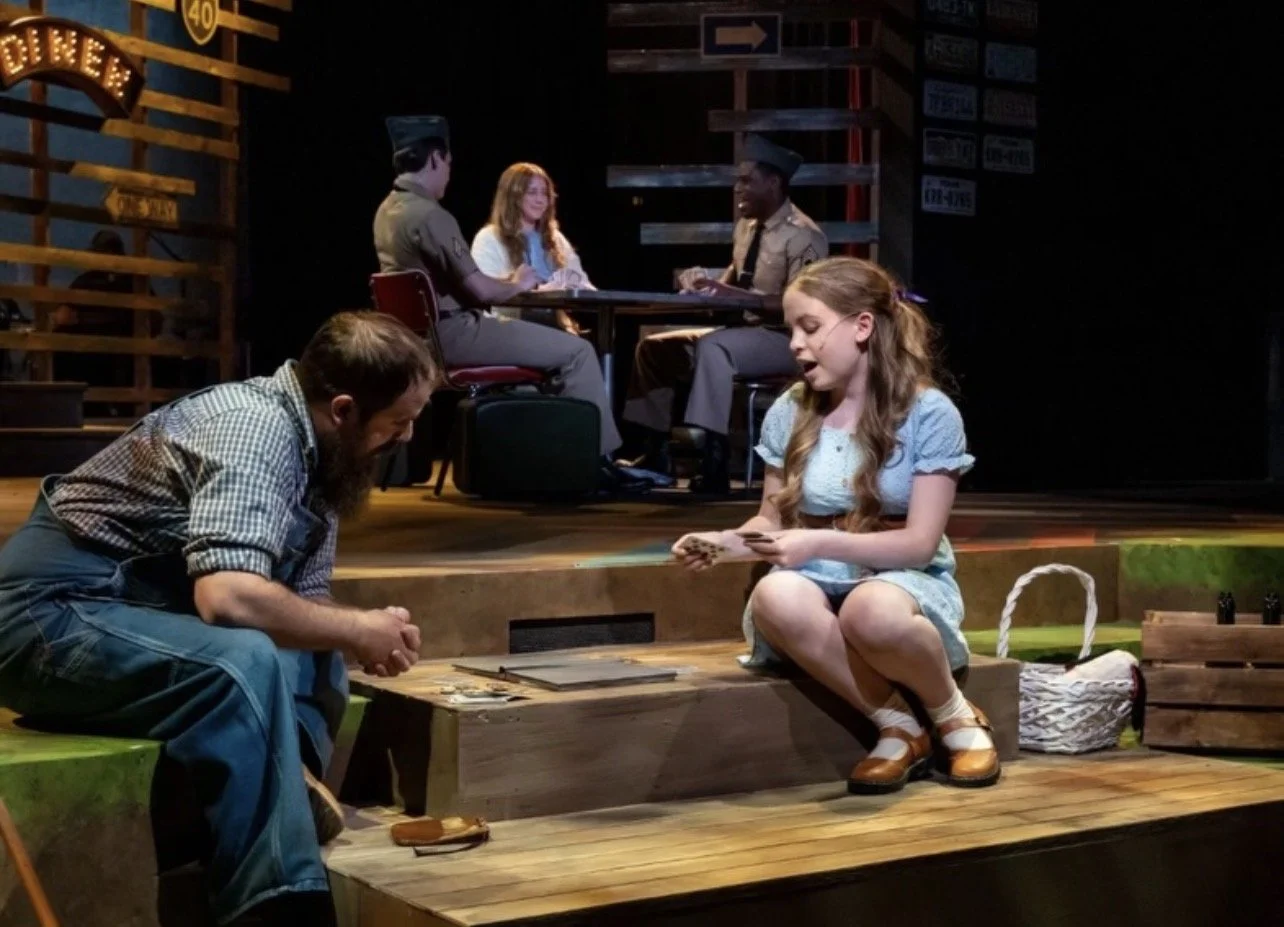
All Production Images by RDG Photography
I sometimes wonder if it is entirely fair to write about a show during a preview performance.
The audience knows, or should know, that preview is still part of the process. The production has one more night to breathe, shift, tighten, and settle before opening itself fully to the public. There is a humility built into that arrangement. We are watching something alive, not laminated.
So consider this less a traditional review than a reflection I found myself unable not to write.
Because even in preview, Aurora Fox Arts Center and Phamaly Theatre Company’s co-production of Violet already had me by the throat.
This was, somehow, my first real experience with Violet. I knew the title. I knew pieces of the score. I knew Sutton Foster had led the 2014 Broadway revival. I knew enough to know the show mattered to people. But I had never sat with it. I had never followed Violet Karl from Spruce Pine, North Carolina to Tulsa, Oklahoma on a Greyhound bus, chasing a miracle she believes will heal the scar on her face. In other words, I got to meet the show almost cold, which is becoming one of my favorite ways to encounter theater.
And yes, at its most practical level, Violet is about a bus.
A bus, a scar, a preacher, two soldiers, a suitcase full of hope, and a young woman who has mistaken transformation for repair.
With music by Jeanine Tesori and book and lyrics by Brian Crawley, Violet is based on Doris Betts’ short story “The Ugliest Pilgrim.” The musical began development through the BMI Musical Theatre Workshop and the Eugene O’Neill Theater Center before premiering Off-Broadway at Playwrights Horizons in 1997. That production won both the New York Drama Critics’ Circle Award and the Lucille Lortel Award for Best Musical, and the piece later returned to larger attention through the 2013 Encores! Off-Center staging and the 2014 Broadway revival led by Sutton Foster.
That history matters here because Violet is not a new musical trying to announce itself. It is a work from another theatrical moment being met by a company and community that give it a startlingly immediate reason to exist right now.
Phamaly Theatre Company describes itself as a creative home for theatre artists with disabilities, and its broader work is not simply about offering performance opportunities. It is about reshaping what theatre spaces assume, allow, and value. In co-producing Violet with the Aurora Fox, that mission does not sit beside the story. It walks directly into the center of it.
Before the show even begins, the audience is told something about the room they have entered.
In the lobby, there are fidget spinners, large-print programs, and other access-forward resources available for audience members who may need or appreciate them. Above the stage, a caption screen displays lyrics throughout the performance, but it also does something I found deeply moving in its simplicity: it warns the audience roughly a minute before moments that may include loud sounds, intense material, or flashing lights.
That is not a decorative gesture. It is the kind of thoughtful audience design I wish more productions would adopt. Not because every show needs to become the same kind of room, but because this production seems to understand that access is not an interruption of the theatrical experience. It is part of the theatrical experience. It tells the audience: we thought about you before you arrived.
And then the show begins.
Upon entering the theater, I had an immediate, almost physical response to Nick Renaud’s scenic design. The playing space is framed in layered, angled, abstract walls that stretch the eye all the way to the back of the Aurora Fox’s already deep stage. But somehow, instead of making the space feel cavernous, the design makes it feel like horizon. There is distance here. There is road. There is the sense that Violet is not only traveling across geography but toward an image of herself she has been trying to reach for years.
That visual language is elevated by Brett Maughan’s lighting design, which is, frankly, extraordinary.
I first became aware of Maughan’s work earlier this summer through Anything Goes, where the lighting had already caught my attention. Here, he takes it somewhere even more striking. The design is full of sharp angles, textured shadows, unexpected color, and moments of contrast that make the stage pictures feel carved rather than simply lit.
There are moments when the lighting seems to pull us directly into Violet’s understanding of the world: bright, searching, almost naïve in its belief that beauty and deliverance might be waiting just beyond the next stop. Then, in Memphis, the world shifts into pools of neon, red, and stage light, creating a humming, disorienting atmosphere that made me audibly gasp. I mean that literally. As someone who has spent a lot of time on the technical side of theater, there were images in this production that felt downright transcendent.
The abandoned church may be the one that stays with me longest. In the story, it is not really a church built around service so much as one built around broadcast, performance, and image. But the way Maughan lights it allows us to see the church as Violet sees it, at least for a moment. It has gravitas. It has promise. It has the shape of a miracle before the miracle disappoints her. I got misty-eyed from the design alone, which is not something I say lightly.
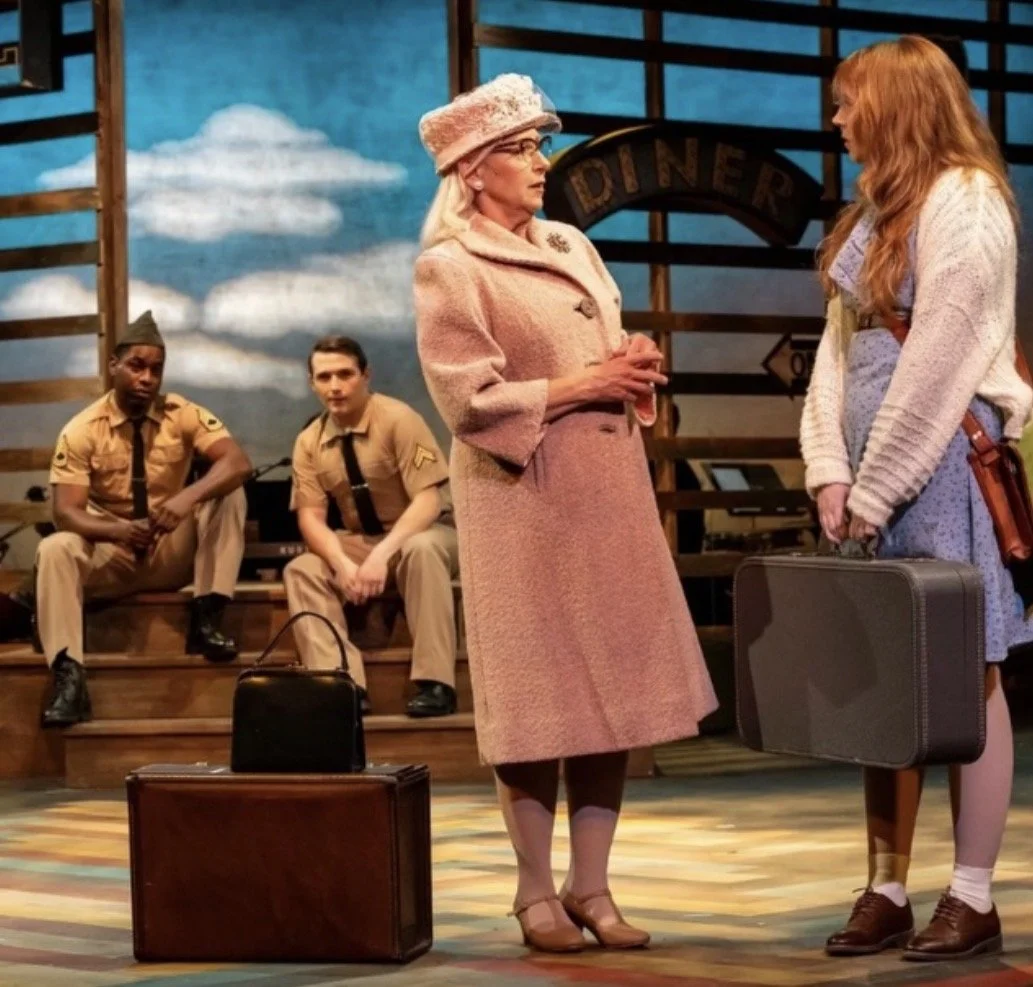
Alexandra Ligh’s costumes and Jeremy Banthoff’s properties design also contribute to a world that feels carefully and lovingly observed. What I appreciated most were the small, human details: the older woman on the bus with her brooches and bangles, applying makeup from a period-appropriate compact; the way clothing and props give characters lived-in histories without needing to announce them.
The show does not call for many extravagant costume moments, but when it does, Ligh knows how to make them count. Alexis Webb’s Lonely Stranger / Music Hall Singer look is a glorious little jolt of visual pleasure, somewhere in the neighborhood of Priscilla Presley in the best possible way. Whoever made that hair choice deserves flowers.
There is also a subtle and beautiful relationship between Young Violet’s dress and older Violet’s dress, which appear to echo one another through fabric while differing completely in cut. That choice quietly tells us something about continuity: the girl and the woman are not separate people. They are the same wound, the same hope, the same body, carried forward.
At the beginning, I found myself looking for Violet’s scar.
I wondered if I was missing it. I wondered whether there was a prosthetic or makeup effect too subtle for me to see from my seat. It is also possible that preview conditions affected what I was seeing. But by the end of the performance, I found myself hoping they leave Violet exactly as she is.
Because the absence of a visible scar becomes one of the production’s most powerful choices.
It forces the audience into a different kind of looking. We do not get to assess the scar, measure it, judge whether Violet’s shame is proportionate, or privately reassure ourselves that we would have treated her kindly. Instead, we are asked to live inside the psychological fact of it. We see what it has done to her without being given the comfort of staring directly at it.
That choice also allows the scar to shift over the course of the evening. At first, its invisibility may create tension. Where is it? What are we supposed to be seeing? But slowly, as the people around Violet begin to see past it, the audience does too. Not because the scar has vanished, and not because Violet has been “fixed,” but because the show has moved our attention somewhere more honest.
Healing, in this production, is not the arrival of beauty. It is the collapse of the idea that beauty was ever the thing that needed to arrive.
That is what makes the partnership with Phamaly feel so meaningful. In a less thoughtful production, Violet could become a story about disability, difference, and bodily shame that still centers an able-bodied audience’s curiosity. Here, the production feels interested in something more complicated and more humane: the exhausting violence of being perceived incorrectly, and the equally complicated freedom of realizing you do not exist to be corrected.
As Young Violet, 14-year-old Meika Qutub is sensational.
Her voice fills the Aurora Fox with an ease that is almost startling, but the voice is only part of it. What impressed me just as much were her acting instincts. Young Violet lives in high-stakes memory for much of the show, and Qutub listens and responds with remarkable presence. There is nothing generalized about her work. She is not “good for her age.” She is good, full stop.
Katelyn Kendrick meets her beautifully as Violet. This is a role made famous in the revival by Sutton Foster, but Kendrick never feels trapped by anyone else’s silhouette. Vocally and emotionally, her Violet feels fully her own. There is a steeliness to her that I really appreciated. She is not simply wounded. She is funny, defensive, sharp, hungry, and sometimes unkind in the way people can become when they have spent years preparing to be hurt before anyone touches them.
One of the things I enjoyed most about this production is how much it trusts the audience to sit in moral middle ground.
That may be my favorite thing about Violet as a piece. It does not offer many people who are entirely right or entirely wrong. It gives us people who are tender, selfish, frightened, charming, cruel, lonely, and capable of grace, sometimes within the same scene. That feels painfully true.
Adam Johnson’s Monty is maybe the clearest example. Johnson gives him a boyish charm that makes it easy to understand why Violet would be pulled toward him, even when we can see the immaturity, carelessness, and damage leaking through the cracks. He has moments that invite you in, then moments that make you want to shove him straight off the bus. That is not an easy line to walk, and Johnson handles it with real care. He does not ask us to excuse Monty. He lets us understand why Violet might.
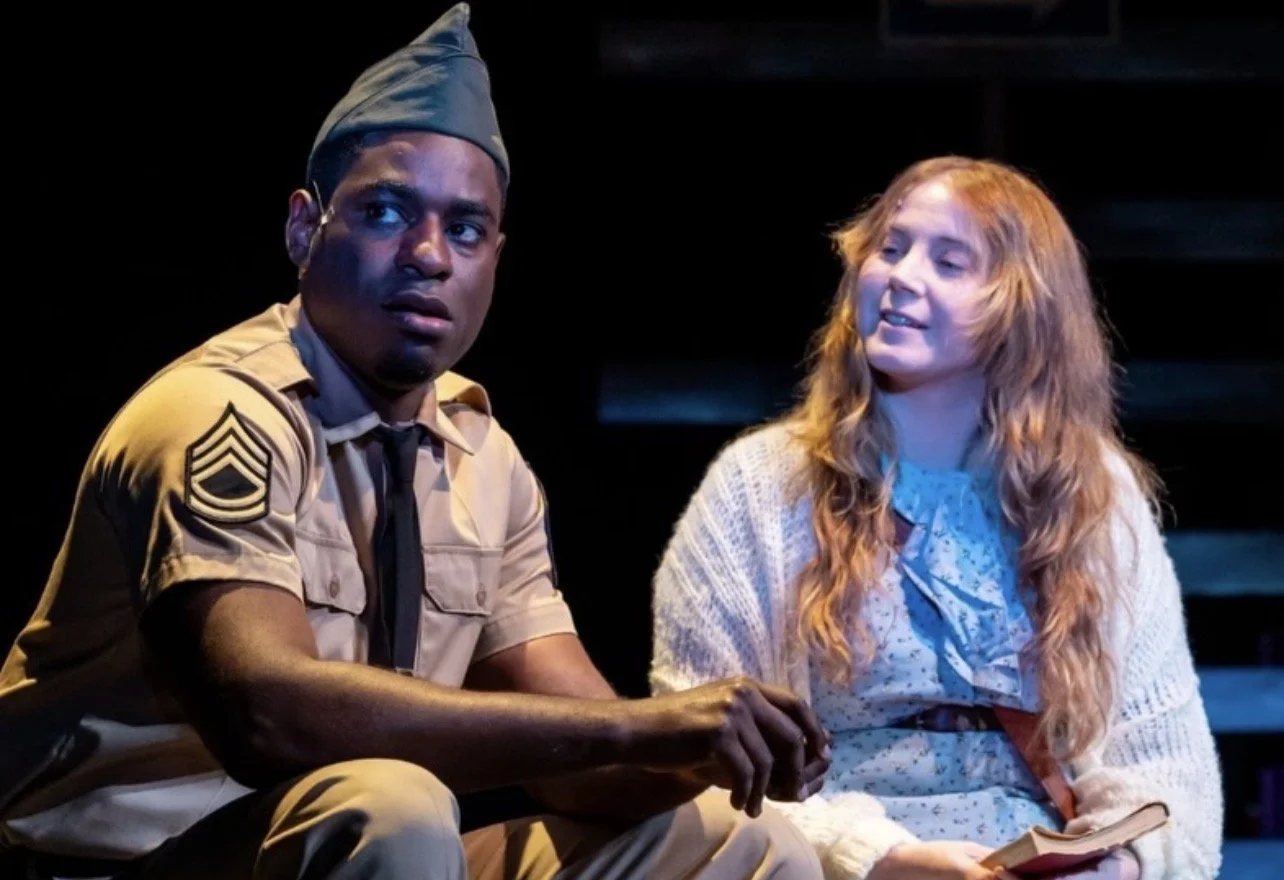
Rakeem Lawrence brings an open-hearted warmth to Flick, and when the character settles into the center of a scene, the production gains a lovely steadiness. There were moments, particularly musically, where it seemed he may have been fighting to hear the band clearly, with a few passages slipping under pitch or briefly loosening from the tempo. But those moments never fully broke the spell of Flick as a character. Lawrence gives him dignity without sanding down his pain, and his chemistry with Kendrick grows in impact as the evening moves forward.
Trenton J. Schindele’s Father is beautifully complex. This role could so easily become a blunt instrument: hard man, bad father, source of trauma, end of conversation. Schindele refuses that simplicity. His Father has brutality in him, yes, but also softness, confusion, and genuine love that has been warped by bitterness and fear. That complexity matters because Violet’s understanding of love has been shaped by him. If he were only monstrous, her confusion would be easier to dismiss. Schindele makes it harder, and therefore better.
Anna Maria High, as Lula Buffington, reminds us that sometimes the correct response to a voice is simply gratitude. When she lets loose, the room knows it. Joanie Brosseau-Rubald makes a wonderful transformation from the sheltered older woman on the bus to a very different presence by the end of Act I, and the specificity of that shift is a pleasure to watch. Erik Sandvold is a perfectly image-obsessed, almost triggering televangelist, all shine and performance where spiritual service ought to be. Brian Watson brings terrific rhythm and oversized energy as the Bus Driver, becoming part of the pulse of Violet’s journey as she moves from stop to stop.
Charlotte Gray, Gabriel Hannah Smothers, Alexis Webb, and the rest of the ensemble do strong work building the social world around Violet, which is essential in a show where the journey only matters if each new room changes the air.
The band, led by music director Heather Iris Holt, gives Tesori’s score the folksy texture and emotional fullness it needs. I have been enjoying the larger musical ensembles in several productions lately, and this one is no exception. With violin, cello, guitars, piano, and more, the musicians create a sound that feels rooted without becoming quaint. The score moves through American roots, folk, gospel, blues, and country influences, and the production lets that musical mixture carry both motion and memory.
If I have a reservation, it is with the material itself more than this production. The final build toward Violet’s emotional reckoning arrives a little faster than I wanted it to. There is so much moral, spiritual, and psychological material in the last stretch of the show that I found myself wanting more room to sit in the rupture before the healing. But even that response may simply be a sign that the production had drawn me in deeply enough that I wanted more time with the wound before being asked to watch it close.
Director Ben Raanan writes in his program note about his own relationship to disability and performance, and about how Violet has stayed with him as a story about rejection, survival, and the bravery of continuing to search for transformation. He also writes that if only the characters were brave enough to get on the bus, they were brave enough to get on the bus.
That idea has stayed with me.
Because Violet is not really about whether a miracle happens in Tulsa. Not exactly. It is about the dangerous courage of believing your life could still change. It is about the places we go because we think healing is waiting there, only to discover the journey has been showing us something else the entire time.
Aurora Fox and Phamaly’s Violet is thoughtful, visually stunning, beautifully sung, and deeply cared for from the lobby to the final image. It understands that access is not separate from artistry. It understands that disability is not a metaphor to be borrowed and returned. It understands that the audience does not need to be told what to think in order to be trusted with something difficult.
Most of all, it understands that being seen is not the same thing as being fixed.
And sometimes, the most meaningful kind of healing begins when the world stops asking you to become easier to look at.