There is a particular kind of theatergoing conundrum that I find both fascinating and, in a very specific way, exciting.
What do you do with a production that contains a tremendous amount of great, genuinely impressive work, when the show itself keeps making that good work harder to receive?
That was the question I kept circling while watching Roald Dahl’s Matilda the Musical at Candlelight in Johnstown. I laughed a lot. Like a lot. I admired the cast even more than I expected to. I watched a room full of families and young theatergoers have a genuinely wonderful night at the theater. I also spent large portions of the evening trying to sort through a musical that, to my ear, has a deep and persistent tonal problem.
Before going any further, it feels important to separate the show from the production, because Candlelight’s cast is not phoning this in. Quite the opposite. They are working hard enough to make you tired on their behalf.
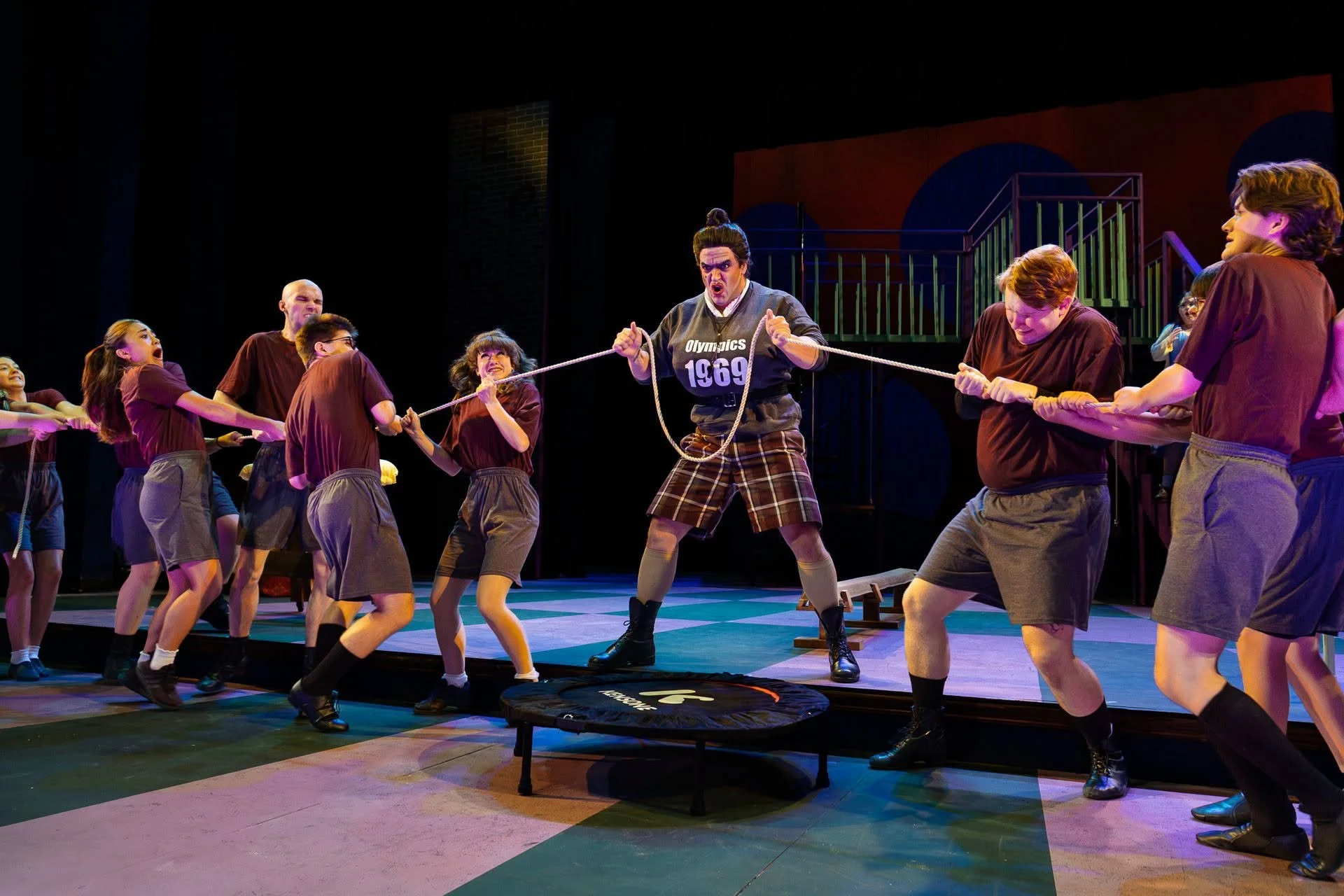
Photo Credit: The Creative Agency
Matilda the Musical, with book by Dennis Kelly and music and lyrics by Tim Minchin, is based on Roald Dahl’s beloved novel about a brilliant little girl with cruel parents, an even crueler headmistress, and a mind powerful enough to change her own life. The musical began with the Royal Shakespeare Company and was first performed in Stratford-upon-Avon in 2010 before making its way to Broadway, where it opened at the Shubert Theatre in 2013 and ran through 2017 for 1,554 performances. The Broadway transfer was not some small, scrappy curiosity either. It won four Tony Awards, with a special Tony Honor for the four girls who played Matilda, and the London production has continued to become one of the major long-running musical exports of the last decade and a half.
On paper, it makes perfect sense for Candlelight. Their production runs June 25 through August 30, and the theater’s own description frames it as a Tony Award-winning family show about childhood, imagination, and one girl’s quest for a better life. It is easy to see the appeal. There are two casts of young performers, a recognizable title, enough adult humor to keep the grown-ups engaged, and a finale that practically begs the room to erupt. For a dinner theater with Candlelight’s audience, Matilda is an obvious choice.
It is also a dense, strange, tonally restless piece of writing.
The score has a lot of words. A lot. That is not automatically a problem, and in fact, Minchin’s lyrics often have a clever, jagged intelligence that makes sense for a show about children pushing back against adult cruelty. But in this production, the combination of quick lyrics, thick British dialect work, and a sound mix that could have been pushed significantly harder meant large sections of the score became (for this reviewer) difficult to understand.
That is especially challenging in Matilda, because the show does not always give the audience simple emotional roads to follow. It gives us rapid-fire language, narrative detours, grotesque adults, fantasy sequences, schoolyard rebellion, domestic abuse played somewhere between horror and cartoon, and a late-arriving supernatural element. When that much of the architecture depends on language, any loss of that clarity made me struggle to keep up.
And yet, the cast never let me go and always kept finding ways to pull me back.
The commitment of this cast is truly ‘lighting in a bottle’, leaning hard into physical comedy, sometimes to the point of delightful absurdity. There were stretches of the show where I was laughing hard enough to forget how much I was wrestling with the piece itself. But that also creates the central tension of the evening: the comedy is often what makes the show playable, and it is also what keeps widening the canyon where perhaps the stakes are supposed to be.
I found myself wondering whether the cast had made the better of two difficult choices. Play the material more sincerely and risk exposing how unwieldy the book can be, or attack the comedy with full abandon and keep the audience riding the wave, even if the emotional stakes become harder to believe.
Candlelight’s production chooses the wave, and I give so much respect for it.
Patric Case’s Trunchbull is a major reason that choice works as often as it does. Case gives the role a grotesque physical precision that feels completely committed and original. The walk and overall physical language, the vocal attack, the sheer disgust radiating toward the children around him, it is all big, strange, and carefully calibrated. Trunchbull is a hard role because the character has to be monstrous, funny, and frightening, often at the same time. Case understands the theatrical size required and brings a boldness to the stage that keeps the audience alert whenever he enters.
Nikki Salinas gives Mrs. Wormwood the correct amount of tacky confidence, never asking us to soften toward a woman who is absurdly, even impressively, uninterested in her own child. Grant Kinzie’s Michael Wormwood is a wonderfully specific little pocket of weirdness, committing fully to a character who could easily disappear into the background if played with less focus. Together, the Wormwoods become one of the production’s most reliable sources of comic energy. Brandon Sutorius, who already proved earlier this summer in Anything Goes that he is a wildly inventive physical comedian, once again shows just how much he can do with a character. As Rudolpho and in his other ensemble work, Sutorius has the kind of out-of-the-box comic instinct that makes a moment feel newly discovered, even when you can tell it has been carefully built.
The Creative Agency
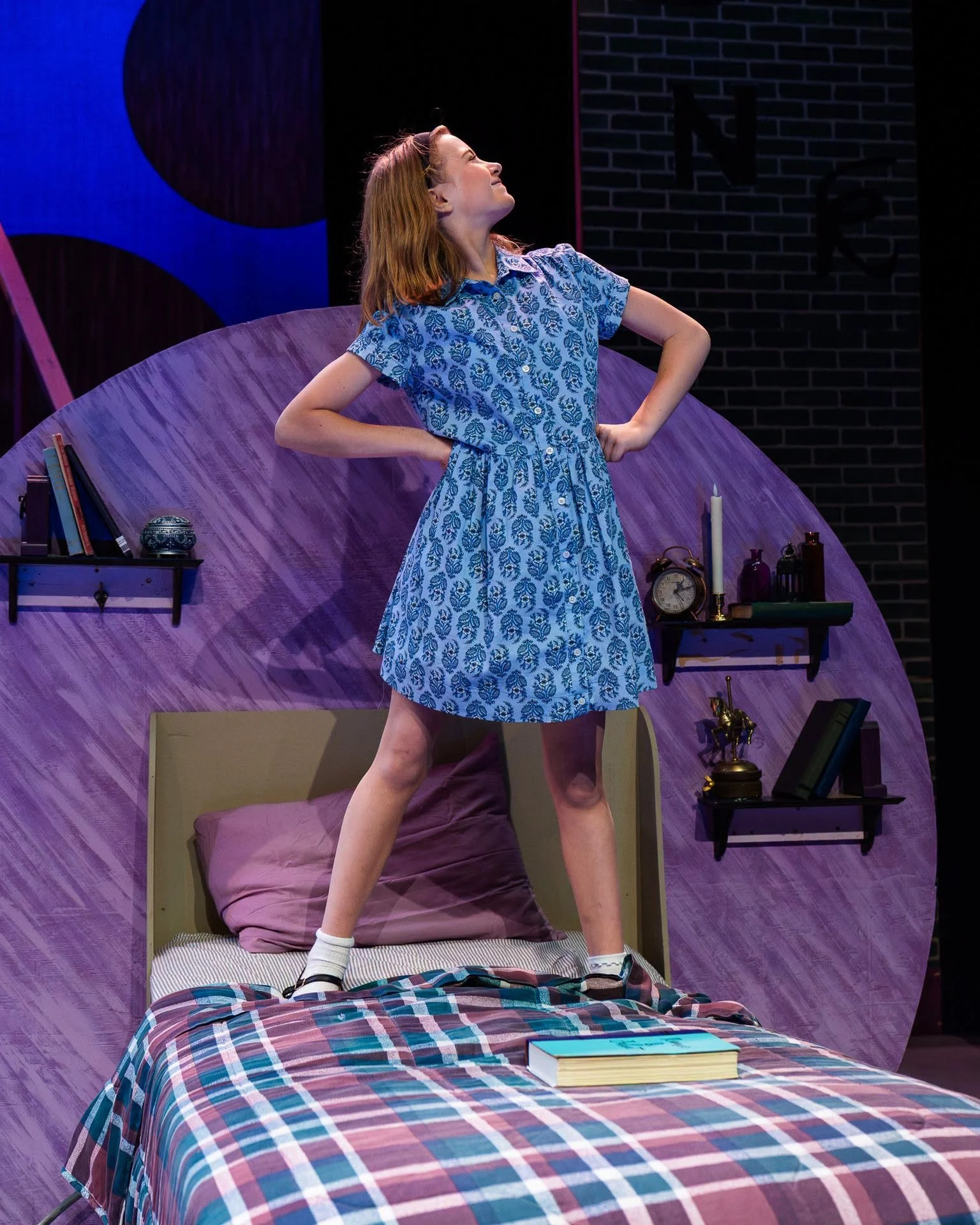
On the night of this review, Khloe Trainor played Matilda, and she was outstanding. It is a brutal role for a young performer, not only because of the vocal demands, but because Matilda has to carry intelligence, loneliness, anger, imagination, and stillness in a show that often refuses to sit still around her. Trainor occasionally fought the same diction and sound challenges that affected the larger production, especially in the storytelling passages, but her Act II “Quiet” was the emotional center of the evening for me personally. She took her time. She did not push for sentiment. She let the song land as an actual private moment, and for the first time in a while, the noise of the show seemed to fall away. I believed her completely.
I also saw Gracie Woo as Miss Honey, and she was remarkable. Miss Honey can become a wash of sweetness in the wrong hands, but Woo brought a softness that never felt empty. There was real pain under her gentleness, and a lovely, steady presence in the way she listened to Matilda. In a production that often runs toward the loudest possible choice, Woo gave us something quieter and more grounded. The show needed that.
That is part of what made the evening so complicated. There is excellent work here. There is also a production that, from a design and storytelling standpoint, felt inconsistent in ways I could not ignore.
Carrie Colton’s choreography starts with a sharpness in Act I that made me genuinely excited for where the show might go. There is an edge to the movement vocabulary early on, a kind of angular schoolyard attack, that suits the material beautifully. It understands the children not as precious little musical theater machines, but as bodies full of revolt. Then, as the evening continues, that choreographic bite seems to soften. There are still effective moments, of course, but I missed the danger and precision that appeared to be promised early in the production.
The lighting design by Vance McKenzie was maybe the most frustrating element for me because there were flashes of real artistry inside it. Certain images suggested a thoughtful subliminal language at work, moments where shadow, isolation, or color seemed to be telling us something about power and fear. Then long stretches would pass where the stage felt underlit or overly dependent on spotlight in a way that flattened the world rather than sharpening it. For a musical that already swings wildly between cartoon grotesque and emotional seriousness, the lighting needed to help us understand where to look and how to feel inside those shifts. Too often, I felt it doing the opposite.
Ranae Selmeyer’s scenic design has some interesting ideas, especially in the angled structure at the back of the stage, which evokes a jungle gym, a schoolyard, and a slightly warped child’s climbing frame all at once. When used actively, particularly during the beginning of Matilda’s Acrobat and Escapologist story, it has real promise. I found myself wishing the production had leaned into that structure more fully. It was the most compelling scenic idea onstage, but it did not feel used as thoroughly as it could have been.
Some of the inconsistency came in smaller choices that pulled me out of the world. Early in the show, Miss Honey’s classroom is represented with an oversized chalkboard. Later, that visual language shifts into what reads as a whiteboard, which only fully makes sense once the final portion of Matilda’s story is projected onto it. The projection itself is a cool technical effect, but by that point, the storytelling vocabulary had already been established through beautiful live embodiment by Chloe Wheeler and Carter Edward Smith. Suddenly moving into projection felt less like an evolution and more like a disruption. I understood why it was happening, but I was aware of myself understanding it, which is very different from simply being carried by it.
That is also how I felt about some of the book’s stranger choices. Late in the show, characters begin speaking directly to the audience in ways that had not been established as part of the production’s language. Matilda’s telekinesis also arrives with surprisingly little dramatic build, considering how central it becomes to the final unraveling of the story. These are not issues Candlelight invented. They are baked into the musical. But this production did not always solve them, and at times, it seemed to heighten how abrupt they are.
The sound mix also kept the evening from landing with the force it needed. “Revolting Children” should feel like the roof is in danger. It should send electricity through the room. On this night, it simply did not. Whether the young cast was tired, the mix was conservative, or the energy had been spent elsewhere, the number felt sonically held back when it needed to explode. That matters because the entire musical is angling toward that release. If the revolt does not rock the building, the catharsis is blunted.
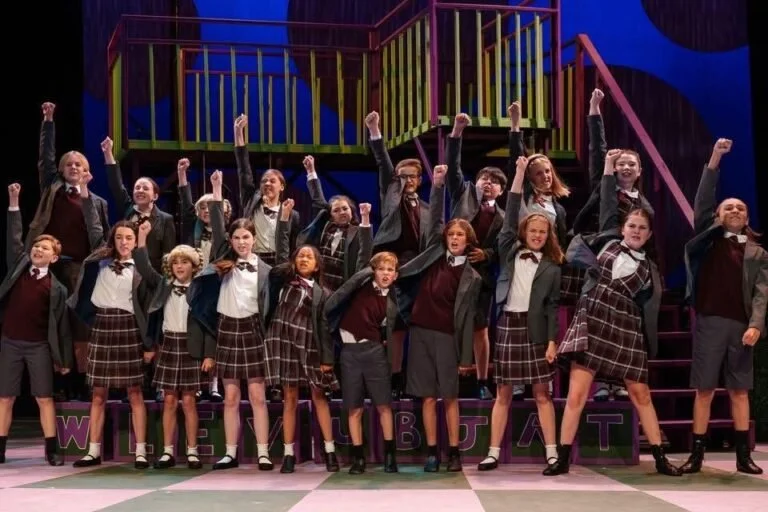
Photo credit: The Creative Agency
That said, the young performers in the Blue Cast deserve real credit. This is a demanding show, and not just in the cute “look at all these talented kids” way. They are responsible for dense music, stylized movement, dialect, comedy, and a level of stamina that would be challenging for adult performers. Even when the production around them did not fully cohere, their discipline and commitment were easy to admire.
That may be the fairest way to describe the evening as a whole: easy to admire, harder to believe.
I admired the labor. I admired the comic invention. I admired Trainor’s emotional control, Woo’s tenderness, Case’s ferocious commitment, Sutorius’s physical wit, and the sheer amount of energy the ensemble poured into the room. I also found myself repeatedly bumping against a musical that seems to want anarchy, sentiment, satire, danger, family entertainment, and trauma recovery all at once, without always building the bridges between them.
For some audiences, that may not matter. And honestly, I understand why. Matilda is colorful, funny, recognizable, and full of children sticking it to cruel adults. There is pleasure in that. Candlelight knows its audience, and this production gives families plenty to enjoy.
But as a theatergoer, and especially as someone who likes thinking about why a production works or does not work, I left tangled.
Sometimes that is valuable. A clean reaction is not always the most interesting one. There is something exciting about a show that makes you sit up, question your own response, and pick apart the difference between the writing, the direction, the design, and the performances. I had a lot to think about after Matilda.
I just wish more of that thinking had been about what the production revealed, and less about what it was fighting.
Candlelight’s Matilda is not without joy. It is not without talent. It is certainly not without effort. The cast works incredibly hard, and often, they are the reason the evening stays afloat. But the production also exposes the musical’s tonal whiplash and occasionally adds new confusion of its own.
So the conundrum remains.
I left grateful for the performers, frustrated by the storytelling, impressed by individual moments, and still not entirely convinced by the show carrying them.
Maybe that is not the cleanest response.
But it is an honest one.